The Impact of Space Weather on Satellite Communications and Global Infrastructure
Space weather refers to the variable conditions in the near-Earth space environment, including the Sun and interplanetary space, that can influence the performance and reliability of technological systems both in space and on Earth [1].
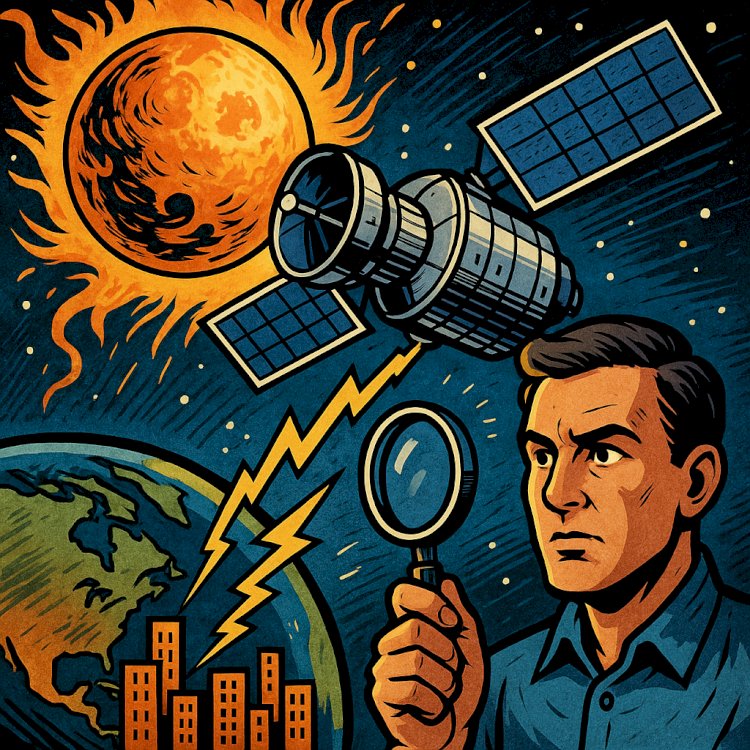
This complex phenomenon encompasses three primary manifestations that originate from our Sun's dynamic magnetic activity.
Solar flares represent the most explosive events in our solar system, characterized as intense bursts of electromagnetic radiation that release energy equivalent to billions of hydrogen bombs[2]. These eruptions occur when twisted magnetic field structures in the Sun's corona suddenly realign through magnetic reconnection, releasing electromagnetic energy across the entire spectrum from radio waves to gamma rays[3][4]. Solar flares are classified on a scale from A-class (weakest) to X-class (strongest), with each letter representing a ten-fold increase in energy output, similar to the Richter scale for earthquakes[5][2].
Coronal Mass Ejections (CMEs) constitute massive expulsions of plasma and magnetic field from the Sun's corona, capable of ejecting billions of tons of coronal material into space[6]. These events can travel at speeds ranging from 250 kilometers per second to nearly 3,000 kilometers per second, with the fastest Earth-directed CMEs reaching our planet in as little as 15-18 hours[6]. CMEs expand significantly as they propagate through space, with larger ejections potentially encompassing nearly a quarter of the space between Earth and the Sun by the time they reach our magnetosphere[6].
Geomagnetic storms result when CMEs interact with Earth's magnetic field, transferring energy into our upper atmosphere and causing variations in the planetary magnetic field[7]. These disturbances create electrical currents in the ground beneath much of the affected region and can produce spectacular auroral displays visible far from their typical polar locations[7][8]. The intensity of geomagnetic storms is measured on the NOAA G-scale from G1 (minor) to G5 (extreme), with extreme events capable of affecting power grids, communications, and satellite operations globally[7].
Vulnerability of Satellite Systems to Space Weather
Modern satellite systems face unprecedented challenges from space weather events, with impacts ranging from temporary disruptions to permanent damage. The increasing reliance on satellite technology has made these vulnerabilities particularly concerning for both commercial and government operations.
Electronic System Failures and Radiation Effects
Space weather events can cause sudden satellite electronics failures through multiple mechanisms[9][10]. During major solar storms, currents induced by charged particles can trigger unexpected satellite behaviors, including data outages, system reboots, and even unwanted thruster firings[11][12]. The 2003 Halloween Storms demonstrated this vulnerability dramatically, with NASA's Goddard Space Science Mission Operations Team reporting that 59% of NASA's Earth and space science satellites were affected in some way[11][12].
High-energy particles accelerated by CMEs can penetrate satellite shielding and damage sensitive electronic components[7][13]. This radiation can cause both immediate single-event effects, where a particle strike alters the state of electronic components, and cumulative total dose effects that gradually degrade performance over time[14]. Modern satellites increasingly rely on commercial off-the-shelf electronics rather than expensive radiation-hardened components, making them more susceptible to space weather impacts[13].
Orbital Mechanics and Atmospheric Drag
Space weather significantly affects satellite orbits through atmospheric heating and expansion[15][16]. During geomagnetic storms, the upper atmosphere can heat up and expand substantially, increasing atmospheric drag on low Earth orbit satellites[17]. This phenomenon was starkly illustrated during the May 2024 solar superstorm, when satellites and space debris objects were sinking toward Earth at a rate of 590 feet per day, forcing thousands of spacecraft to fire their thrusters simultaneously to maintain altitude[16].
The International Space Station has experienced direct operational impacts from space weather, including attitude control problems caused by increased atmospheric density during solar flares[18]. In 2006, a massive solar flare increased atmospheric density to approximately 2.5 times normal levels, causing software convergence problems with the station's attitude control system[18].
GPS and Navigation System Disruptions
Global Positioning System accuracy can be severely compromised during space weather events due to ionospheric disturbances[19][20]. Under normal conditions, civilian GPS units typically have an accuracy of about 16 feet, but during sunspot activity, this inaccuracy can exceed 32 yards[19]. The ionosphere's electrical properties change dramatically during solar storms, delaying and distorting GPS signals as they travel from satellites to ground receivers[19].
The May 2024 Gannon Solar Storm provided a stark example of GPS vulnerability, with location signals off by up to 230 feet during the worst conditions[20]. This disruption lasted for up to two days in some U.S. regions, causing GPS-guided farming equipment to behave erratically and costing American farmers more than $500 million in losses[20]. Aircraft navigation systems were similarly affected, with errors extending "way beyond" the four-meter tolerance window typically compensated for in aviation applications[20].
Ground-Based Infrastructure Disruptions
The impacts of space weather extend far beyond satellites, affecting critical terrestrial infrastructure systems that modern society depends upon for daily operations.
Power Grid Vulnerabilities and Transformer Damage
Geomagnetic storms pose one of the most serious threats to electrical power grids through the generation of geomagnetically induced currents (GICs)[21][22]. These quasi-DC currents can exceed 20 times the peak value of normal magnetizing currents in power transformers, causing half-cycle saturation that leads to increased reactive power consumption, harmonic distortion, and dangerous stray flux heating[22].
The 1989 Quebec blackout exemplifies the devastating potential of space weather on power infrastructure[8][23]. On March 13, 1989, geomagnetically induced currents found a weakness in Quebec's electrical system, causing the entire provincial power grid to lose electricity in less than two minutes[8][23]. The 12-hour blackout that followed left millions of people trapped in dark buildings, stalled elevators, and underground tunnels, while closing schools, businesses, and transportation systems[8][23].
Power transformers represent particularly vulnerable components, with tests on 500/230 kV transformers showing reactive power loss increasing from 1 MVAr during normal operation to 40 MVAr during geomagnetic events with just 25 amperes induced in each phase[22]. A severe geomagnetic storm could potentially disrupt the nation's power grid for months, with damage and disruption costs exceeding $1 trillion and full recovery taking months to years[24].
Aviation Industry Impacts
The aviation industry faces multifaceted challenges from space weather, particularly affecting high-latitude and polar operations where space weather effects are most pronounced[25][1]. During the 2003 Halloween Storms, airline pilots frantically changed course as almost every flight over Earth's poles was rerouted to lower latitudes to avoid radiation exposure, with costs reaching up to $100,000 per flight[11][12].
Space weather can degrade or completely disrupt High Frequency radio communications that airlines depend on for long-distance communication[25][1]. The May 2024 solar storm caused transpolar flights to be cancelled or diverted as communication systems became unreliable[26]. GPS-dependent navigation and surveillance systems also experience degraded performance during space weather events, affecting both flight safety and air traffic management efficiency[27][28].
Recent research has revealed that space weather events systematically modulate flight delays, with clear correlations between magnetospheric-ionospheric disturbances and aviation operational efficiency[29]. This represents a previously unrecognized economic impact that compounds the direct safety concerns already driving industry response protocols[29].
Communication System Failures
Space weather events can cause widespread communication blackouts through multiple pathways[7][19]. Solar flares immediately disrupt short-wave radio communications on the sunlit side of Earth by increasing ionization in the lower ionosphere layers, where radio waves lose energy through more frequent collisions[3]. During the 1859 Carrington Event, telegraph systems worldwide experienced sparking and fires, with some operators receiving electric shocks[30][31].
Modern communication systems face similar vulnerabilities, with space weather causing dropped calls at cell towers and disrupting all types of Earth-based communications[19]. The increasing dependence on satellite-based communication systems creates additional points of failure, as these systems can experience both direct radiation damage and signal propagation issues during severe space weather events[7][1].
Historical Case Studies of Major Space Weather Events
Examining historical space weather events provides crucial insights into the real-world impacts and vulnerabilities that continue to shape our understanding of these phenomena.
The Carrington Event of 1859: The Ultimate Benchmark
The Carrington Event remains the most intense geomagnetic storm in recorded history, occurring on September 1-2, 1859[30][32]. This event was triggered by a coronal mass ejection that traveled directly toward Earth in just 17.6 hours, significantly faster than the typical multi-day journey[30][32]. The associated solar flare was the first ever scientifically observed and recorded, independently documented by British astronomers Richard Carrington and Richard Hodgson[30][32].
The geomagnetic disturbance was so intense that auroras were visible as far south as the Caribbean, with New Yorkers able to read newspapers by the bright night sky and gold miners in the Rocky Mountains waking at 1 AM thinking it was morning[31][33]. Telegraph systems worldwide experienced catastrophic failures, with operators reporting sparks, fires, and electrical shocks[30][31]. Some telegraph lines continued operating solely on the induced electrical currents from the geomagnetic storm, even after their power sources were disconnected[31].
If a Carrington-level event occurred today, experts estimate it could cause high-voltage electrical transformers to overheat globally, leading to widespread blackouts and potentially trillions of dollars in economic damage[33]. The event serves as a critical benchmark for understanding the upper limits of space weather impacts on modern technological infrastructure[33].
The 1989 Quebec Blackout: Modern Infrastructure Vulnerability
The March 1989 geomagnetic storm provided a stark demonstration of modern power grid vulnerability to space weather[8][23]. The event began with a powerful solar explosion on March 10, releasing a billion-ton cloud of gas that traveled toward Earth at one million miles per hour[8][23]. When this plasma cloud struck Earth's magnetic field on March 12, it created geomagnetically induced currents throughout North America's subsurface[8][23].
At 2:44 AM on March 13, these currents found a critical weakness in Quebec's electrical system, causing a cascading failure that brought down the entire provincial grid in under two minutes[8][23]. The resulting 12-hour blackout affected millions of people, shutting down the Montreal Metro during morning rush hour, closing Dorval Airport, and forcing people to endure cold homes and dark office buildings[8][23].
The Quebec blackout was not an isolated incident but part of broader North American impacts[23]. New York Power lost 150 megawatts the moment Quebec's grid failed, and utilities across the United States experienced their own operational challenges[23]. This event highlighted the interconnected nature of power grids and demonstrated how space weather effects in one region can cascade across continental infrastructure networks.
The 2003 Halloween Storms: Satellite Constellation Impacts
The Halloween Storms of October 28-31, 2003, marked a turning point in understanding space weather impacts on satellite operations[11][12]. These events featured two of the strongest solar flares of the Space Age: an X17 flare on October 28 followed by an X10 flare on October 29, both hurling fast-moving CMEs directly toward Earth[11][12].
The storms had unprecedented impacts on satellite operations, with what researchers now call "half of Earth's satellites lost" - not destroyed, but temporarily misplaced[11][12]. The majority of satellites in low Earth orbit required several days of around-the-clock work to reestablish their positions after the storms pumped an extra 3 terawatts of power into Earth's upper atmosphere[11][12]. This atmospheric heating caused significant orbital perturbations that overwhelmed tracking systems' ability to maintain accurate satellite position data.
Beyond positional tracking, the Halloween Storms caused widespread satellite anomalies, including data outages, system reboots, and uncontrolled thruster firings[11][12]. Some satellite operators simply shut down their instruments rather than risk permanent damage[11][12]. The International Space Station crew took shelter in hardened compartments to protect against high-energy particle radiation[11][12].
Recent Events: The May 2024 Gannon Solar Storm
The May 2024 solar superstorm, later named after deceased space weather scientist Jennifer Gannon, represented the strongest space weather event to hit Earth in over 20 years[16][20]. This G5-level storm caused thousands of satellites to experience what researchers termed the largest "mass migration" in orbital history as spacecraft simultaneously maneuvered to maintain altitude amid sudden atmospheric expansion[16].
The agricultural sector bore significant economic impacts, with GPS-guided farming equipment acting erratically during peak planting season[20]. GPS receivers showed errors of up to 230 feet, with disruptions lasting up to two days in some regions and costing American farmers more than $500 million[20]. The event demonstrated how modern precision agriculture's dependence on GPS technology creates new vulnerabilities to space weather that didn't exist during previous major storms.
Forecasting, Mitigation, and Policy Frameworks
Modern space weather preparedness relies on sophisticated forecasting systems, technological mitigation strategies, and coordinated international policy frameworks to protect critical infrastructure.
Advanced Forecasting Technologies
NOAA's Space Weather Prediction Center operates as the primary U.S. forecasting authority, utilizing multiple sophisticated models to predict space weather impacts[34][35]. The recently deployed WAM-IPE (Whole Atmosphere Model and Ionosphere Plasmasphere Electrodynamics Model) represents a breakthrough in coupled space weather modeling, providing forecasts up to seven hours earlier by ingesting real-time solar wind data from the DSCOVR spacecraft[36][37].
The ENLIL model serves as a cornerstone tool for forecasting solar wind variations and CME arrival times, helping forecasters gauge both timing and magnitude of approaching solar events[34]. Complementing this, the D-RAP (D-Region Absorption Predictions) model provides visual tools for identifying regions likely to experience radio blackout conditions from X-ray flares or solar energetic particle events[34].
Emerging machine learning approaches show promise for enhancing predictive capabilities[38]. Researchers are developing algorithms that predict future solar surface conditions based on real-time solar imagery and historical patterns, potentially enabling 24-hour forecasts of space weather conditions for mission-critical operations like lunar landings[38].
Satellite Hardening and Protection Strategies
Radiation hardening represents the primary defense mechanism for protecting satellite electronics from space weather effects[14]. This approach involves using specialized radiation-hardened components designed to resist both single-event effects and cumulative radiation damage[14]. However, traditional radiation-hardened electronics are expensive and often lag behind commercial technology advances[13].
Innovative materials science approaches are emerging as alternatives to purely electronic solutions[13]. CSIRO has developed metal matrix composites that provide superior radiation shielding while maintaining structural integrity and minimizing weight penalties[13]. Ground testing demonstrates 40-50% improvement in proton radiation protection compared to standard aluminum alloy, with the technology scheduled for space flight testing on CubeSat missions[13].
Operational mitigation strategies include safe mode protocols that automatically protect critical satellite systems during severe space weather events[15]. During the May 2024 storm, NASA's ICESat-2 satellite successfully transitioned into safe mode to protect its systems when attitude control became questionable[15]. These automated responses represent crucial failsafe mechanisms that can prevent permanent damage even when ground controllers cannot intervene in time.
International Policy and Coordination Frameworks
The World Meteorological Organization (WMO) has established comprehensive four-year plans for coordinating international space weather activities, recognizing that space weather impacts transcend national boundaries[39]. These plans integrate space weather observations into the WMO Integrated Global Observing System (WIGOS) and establish consistent data sharing protocols through the WMO Information System[39].
The International Civil Aviation Organization (ICAO) has developed operational space weather services for international air navigation, publishing the Manual on Space Weather Information in Support of International Air Navigation[1]. This framework provides standardized guidance for aeronautical meteorologists, operators, and flight crews on incorporating space weather information into aviation operations[1].
The International Telecommunication Union (ITU) has recognized space weather as a critical concern requiring international coordination, particularly as our dependence on space-based communication systems continues to grow[33]. Recent initiatives focus on developing preparedness frameworks for potential Carrington-level events that could devastate global telecommunications infrastructure[33].
Economic Risk Assessment and Industry Response
Comprehensive economic impact studies reveal the enormous financial stakes involved in space weather preparedness[40][41]. Lloyd's of London estimates that a major solar storm could result in global economic impacts reaching $2.4 trillion over five years, with insurance industry losses potentially ranging from $55 billion to $334 billion[41][42]. These figures dwarf the combined impacts of major hurricanes and underscore the need for robust mitigation investments.
The satellite industry, with global revenues estimated at $269 billion in 2017 and growing rapidly, faces particular exposure to space weather risks[43]. Recognition of these vulnerabilities has driven increased investment in both forecasting capabilities and protective technologies[43]. NOAA's expanded commercial weather data programs, including recent $3.8 million contracts for satellite-based atmospheric monitoring, reflect government recognition of the critical need for enhanced space weather observation capabilities[44].
Conclusion: Building Resilience in an Interconnected World
The investigation into space weather impacts on satellite communications and global infrastructure reveals a complex web of vulnerabilities that threaten the technological foundation of modern society. From the dramatic satellite constellation disruptions during the 2003 Halloween Storms to the recent agricultural losses during the 2024 Gannon Solar Storm, historical evidence demonstrates that space weather represents a clear and present danger to critical infrastructure systems[11][20].
The economic implications are staggering, with potential global losses reaching trillions of dollars for extreme events and recovery periods extending years rather than months[41][24]. As our dependence on satellite-based services continues to grow and power grids become increasingly interconnected, the potential for cascading failures during major space weather events poses unprecedented challenges for emergency management and infrastructure resilience[43][21].
However, the combination of advancing forecasting technologies, improved satellite hardening techniques, and evolving international coordination frameworks provides reason for cautious optimism[36][14][39]. The key to building effective resilience lies in recognizing that space weather preparedness is not merely a technical challenge but a comprehensive societal imperative requiring sustained investment, international cooperation, and proactive risk management across all vulnerable sectors.
The evidence clearly demonstrates that space weather will continue to pose significant risks to our technological civilization, but with proper preparation, forecasting, and mitigation strategies, these impacts can be minimized and managed effectively[40][38]. The question is not whether severe space weather events will occur again, but whether we will be adequately prepared when they do.
- https://community.wmo.int/en/activity-areas/aviation/hazards/space-weather
- https://science.nasa.gov/sun/solar-storms-and-flares/
- https://www.swpc.noaa.gov/phenomena/solar-flares-radio-blackouts
- https://en.wikipedia.org/wiki/Solar_flare
- https://science.nasa.gov/solar-system/what-is-a-solar-flare/
- https://www.swpc.noaa.gov/phenomena/coronal-mass-ejections
- https://www.foxweather.com/learn/what-is-a-geomagnetic-storm
- https://www.sciencetimes.com/articles/44957/20230721/quebec-blackout-1989-lessons-geomagnetic-storm-shocked-entire-nation.htm
- https://www.the-independent.com/space/solar-storms-earth-satellites-damage-b2584950.html
- https://www.independent.co.uk/space/solar-storms-earth-satellites-damage-b2584950.html
- https://spaceweatherarchive.com/2023/11/01/20-years-later-the-halloween-storms/
- https://spaceweatherarchive.com/2021/10/
- https://research.csiro.au/space/radiation-protection-for-space/
- https://spire.com/spirepedia/radiation-hardening/
- https://www.earthdata.nasa.gov/news/feature-articles/its-always-sunny-space-thats-problem-satellite-teams
- https://www.space.com/may-solar-storm-largest-mass-migration-satellites
- https://www.skyatnightmagazine.com/news/solar-storms-starlink-satellites
- https://www.space.com/3264-space-station-glitch-possibly-caused-solar-flare.html
- https://www.space.com/5524-gps-inaccurate-space-storms.html
- https://www.space.com/astronomy/sun/may-2024-solar-storm-cost-usd500-million-in-damages-to-farmers-new-study-reveals
- https://www.naes.com/what-is-a-geomagnetic-disturbance-and-how-does-it-affect-the-power-grid/
- https://electrical-engineering-portal.com/download-center/books-and-guides/electricity-generation-t-d/geomagnetic-induced-current
- https://michigan-weather-center.org/1989-solar-storm
- https://phys.org/news/2016-09-geomagnetic-storms-nation-electric-power-grid.html
- https://www.ametsoc.org/ams/policy/studies-analysis/space-weather-and-aviation/
- https://www.youtube.com/watch?v=WDXcPeetV-Y
- https://www.faa.gov/nextgen/programs/weather/awrp/space-weather
- https://www.dlr.de/en/so/latest/institute-announcement/dlr-survey-on-the-space-weather-impact-on-aviation
- https://arxiv.org/ftp/arxiv/papers/2209/2209.07700.pdf
- https://en.wikipedia.org/wiki/Carrington_Event
- https://scijinks.gov/what-was-the-carrington-event/
- https://www.wikiwand.com/en/articles/Carrington_Event
- https://www.itu.int/hub/2024/08/solar-storms-are-we-ready-for-another-carrington-event-2/
- https://training.weather.gov/nwstc/spacewx/wmo/tool.html
- https://www.swpc.noaa.gov/products-and-data
- https://www.weather.gov/news/072121-swpc-new-model
- https://www.weather.gov/news/232707-space-weather-prediction
- https://space.umich.edu/9-7m-for-tools-to-improve-forecasts-of-harmful-space-weather/
- https://meetings.wmo.int/INFCOM-3/English/3. SESSION ARCHIVE/INFCOM-3-d08-5(2)-SPACE-WEATHER-4Y-PLAN-draft1_en.docx
- https://www.weather.gov/news/171212_spaceweatherreport
- https://www.lloyds.com/news-and-insights/futureset/futureset-insights/systemic-risk-scenarios/extreme-space-weather/economic-impact
- https://www.artemis.bm/news/solar-storm-space-weather-could-cause-330bn-insured-loss-research/
- https://aerospace.org/sites/default/files/2018-12/COL0019_1218_SPWX_SpaceWeather.pdf
- https://ir.spire.com/news-events/press-releases/detail/235/spire-global-awarded-3-8-million-noaa-contract-for
What's Your Reaction?