The Cold War's Tech Legacy: Was It the 20th Century's Ultimate Innovation Engine?
The Cold War is often credited as the primary catalyst for the 20th century's technological boom. This article explores the monumental impact of the superpower rivalry on computing, space, and nuclear tech, while also examining other crucial drivers like world wars, corporate R&D, and private enterprise to determine its true role in shaping our modern world.
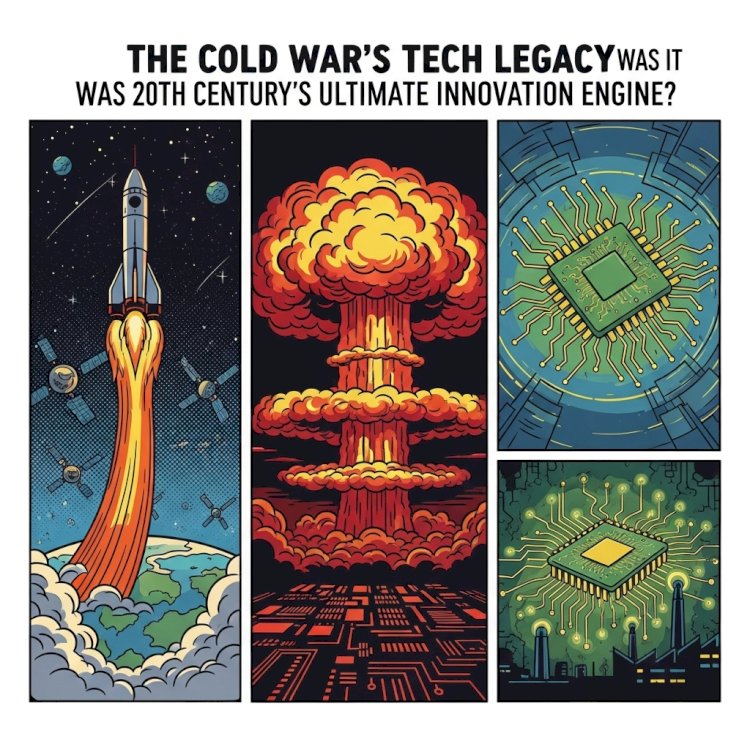
1. Introduction: The Great Acceleration
The 20th century stands as a period of technological acceleration unparalleled in human history. From the first powered flight in 1903 to the birth of the World Wide Web in 1989, the century fundamentally reshaped daily life, communication, medicine, and our place in the cosmos [1]. At the heart of this transformative era lies a period of intense geopolitical friction: the Cold War. This ideological struggle between the United States and the Soviet Union, lasting roughly from 1947 to 1991, is frequently cited as the crucible in which modern technology was forged. But was it truly the primary driver?
This question demands a nuanced exploration. The Cold War was undeniably a powerful catalyst, pouring unprecedented resources into specific technological domains and creating an environment where national survival seemed to hinge on scientific superiority. The Space Race, the development of the internet, and the miniaturization of electronics are direct and undeniable fruits of this rivalry. Yet, to credit the Cold War as the sole or even primary engine of progress risks oversimplifying a complex history of innovation.
This article will argue that while the Cold War was a foundational accelerator and a powerful director of technological development, it was not the singular primary driver. It operated within a broader ecosystem of innovation already fueled by global conflicts like the World Wars, the relentless drive of corporate R&D, the serendipity of individual genius, and the powerful, market-driven forces of private enterprise. We will dissect the direct technological fruits of the superpower standoff, examine the concurrent and alternative drivers of progress, and synthesize these forces to present a more complete picture of how our modern technological world came to be.
2. A Century of Invention Before the Iron Curtain
To understand the Cold War's impact, we must first appreciate the fertile ground of innovation that existed throughout the 20th century. Long before the ideological battle lines were drawn, the century was already humming with transformative inventions. The Wright brothers' first flight in 1903 shattered the boundaries of transportation, and the first aircraft assembly line was established just six years later [2, 3]. Daily life was being steadily revolutionized by inventions like the zipper (1913), the traffic light (1923), frozen food (1923), and Polaroid photography (1932) [1].
In the realm of computing, the conceptual seeds were planted in the 19th century by Charles Babbage and Ada Lovelace [4]. The 20th century saw these concepts materialize into electronic reality. Konrad Zuse in Germany completed the Z3, the world's earliest digital computer, in 1941, while in the United States, John Mauchly and J. Presper Eckert unveiled the ENIAC, the first electronic general-purpose computer, in 1946 [4, 5]. These groundbreaking achievements, occurring before or at the very dawn of the Cold War, demonstrate that the computational revolution was already underway.
Similarly, medical science was experiencing its own revolution. Alexander Fleming's discovery of penicillin in 1928 was a watershed moment that would save countless lives, an event entirely independent of superpower rivalry [6]. This pre-existing momentum across multiple fields - from consumer goods and aerospace to computing and medicine - shows that the 20th century's innovative spirit was not born from the Cold War but was instead supercharged and redirected by it.
3. The Cold War as a Technological Super-Catalyst
The ideological and military standoff between the U.S. and the USSR created a unique pressure cooker for technological development. National prestige and security were inextricably linked to scientific prowess, leading to massive government investment in high-risk, high-reward research and development.
The Sputnik Shock and the Birth of DARPA
On October 4, 1957, the Soviet Union launched Sputnik 1, the world's first artificial satellite. The event sent shockwaves through the American political and scientific communities, creating a palpable fear of falling behind technologically. In direct response, President Dwight D. Eisenhower established the Advanced Research Projects Agency (ARPA), later renamed DARPA, in 1958 [7]. Its mission was clear: prevent future technological surprises and ensure American military superiority. DARPA became a pivotal funding agency for ambitious projects, initially focusing on space, ballistic missile defense, and nuclear test detection [8]. This institutionalization of state-funded, forward-looking research was a hallmark of the era.
The Race to Space and its Earthly Rewards
The most visible manifestation of the Cold War rivalry was the Space Race. This competition to achieve superior spaceflight capability, from launching the first satellite to landing a man on the moon in 1969, yielded a treasure trove of technological spinoffs that have become ubiquitous in modern life [9].
What began as a military requirement for precision navigation for ballistic missile submarines evolved into the Global Positioning System (GPS) that now guides our cars and powers countless applications [10, 11]. Technology developed by the Jet Propulsion Laboratory (JPL) for analyzing images from deep space was adapted to create modern CAT scanners and digital radiography [9]. Materials science saw huge leaps, giving us memory foam (originally developed for aircraft crash protection), scratch-resistant lenses for eyeglasses, and lightweight, fireproof materials now used by firefighters [9]. Even medical devices like infrared ear thermometers, which use technology designed to measure the temperature of distant stars, trace their lineage back to the race for the cosmos [12].
ARPANET: The Military Precursor to the Internet
Perhaps the most transformative Cold War technology is the one you are using to read this. In the late 1960s, DARPA funded the development of the ARPANET, an experimental computer network with a crucial military motivation: to create a decentralized communication system that could withstand a nuclear attack [13]. The network was built on the concept of packet switching, which breaks messages into blocks that can be sent through multiple paths, ensuring redundancy [14]. While its purpose was largely academic, linking Pentagon-funded research institutions, its resilient, decentralized design was a direct reflection of Cold War anxieties. In 1984, the network was split into a military network (MILNET) and a civilian ARPANET, which laid the foundation for the modern internet [13].
Nuclear Escalation and the Drive for Miniaturization
The nuclear arms race, which began with the Manhattan Project in WWII, escalated dramatically during the Cold War. Both superpowers invested heavily in developing more powerful thermonuclear weapons and the missile systems to deliver them [15]. This intense competition had a profound and lasting side effect: an insatiable appetite for computing power and the miniaturization of electronics. To create precision-guided weaponry, tiny, powerful computers had to be crammed into the nose cones of missiles [16].
This military demand was a key driver in the transition from bulky, unreliable vacuum tubes to the transistor, which was invented at Bell Labs in 1947 [17]. The subsequent development of the integrated circuit, a technology heavily supported by military contracts, allowed for the fabrication of complex circuits on a tiny silicon chip. This relentless push for smaller, faster, and more efficient electronics, fueled by the Pentagon, gave the U.S. a significant technological edge and directly spurred the growth of Silicon Valley, paving the way for everything from personal computers to smartphones [16].
4. Beyond Bipolar Rivalry: Other Engines of Innovation
While the Cold War's influence was immense, it was far from the only force at play. Numerous other drivers contributed significantly to the 20th century's technological landscape, often intersecting with and predating the superpower conflict.
The World Wars as Technological Forges
World War I (1914-1918) served as a brutal but effective catalyst for industrial-scale innovation. The horrors of trench warfare spurred the rapid development and mass production of tanks, military aircraft, submarines, and poison gas [18]. The war also saw significant advancements in telecommunications for command and control, as well as medical techniques for treating battlefield casualties [19]. This demonstrated that total war, with its existential pressures, was a powerful driver of technological change long before the Cold War began.
The Power of Corporate Research and Development
Throughout the century, corporate R&D labs served as powerful, self-contained innovation ecosystems. Bell Labs, the research arm of AT&T, is perhaps the most famous example. By bringing together brilliant minds from diverse fields, it fostered an environment of collaborative discovery that produced the transistor in 1947, information theory, the laser, cell phone technology, and the Unix operating system [17, 20].
Similarly, Xerox PARC (Palo Alto Research Center) became legendary for its contributions to personal computing. In the 1970s, its researchers developed the graphical user interface (GUI) and the computer mouse, foundational technologies that would later be commercialized by Apple and Microsoft [21]. These labs demonstrate that sustained progress could be driven by corporate vision and the pursuit of commercial advantage, not just government directives.
The Spark of Serendipity and Collaboration: The Penicillin Story
Innovation is not always a product of grand strategy; sometimes it's born from simple chance. Alexander Fleming’s accidental discovery of penicillin in 1928 is a classic example [6]. However, the journey from a contaminated petri dish to a mass-produced wonder drug illustrates a different kind of driver: collaborative effort accelerated by crisis. It took a team at Oxford University during World War II to purify the substance and prove its efficacy [22]. When wartime Britain lacked the resources for mass production, they turned to the United States. A massive collaborative effort between the U.S. government and private companies like Pfizer led to industrial-scale production, saving countless Allied lives during the war [23]. This story highlights the synergy between individual discovery, academic research, public-private partnerships, and the urgency of global conflict.
The Relentless Force of the Market
Finally, the consumer electronics revolution was driven primarily by private enterprise responding to market demands. From the first transistor radios in the 1950s to the smartphones of today, this evolution has been fueled by competition, the profit motive, and a deep understanding of consumer desires [24]. Private companies are often more agile than government entities, able to take risks and adapt quickly to market signals [25]. The availability of venture capital and other private funding sources creates a dynamic environment where new ideas can be rapidly developed and scaled, a force that operates largely independently of geopolitical rivalries.
5. Synthesis: A Complex Web of Causality
To declare the Cold War the primary driver of 20th-century technology is to ignore the complex, interconnected web of forces that shaped it. A more accurate view emerges when we analyze how these different drivers interacted.
At the peak of the Cold War in the early 1960s, the U.S. government was the undisputed giant of global R&D, accounting for nearly 70% of worldwide expenditures, with national security objectives as the main impetus [26]. This massive public investment established institutions and funded the high-risk, long-term research that the private sector often avoids. It effectively launched many technologies, like spaceflight and the internet, onto their S-curve of technology adoption - the typical path of slow initial growth, followed by rapid adoption, and eventual maturity [27].
However, the dynamic has shifted dramatically since. Today, the private sector's investment in R&D is more than three times that of the public sector in the U.S. [28]. Furthermore, the classic model of military-to-civilian technology transfer has, in many areas, reversed. The defense sector now increasingly relies on innovations from the civilian world, particularly in fields like artificial intelligence, cybersecurity, and computing [29].
Ultimately, the Cold War's greatest technological contribution was not as a sole creator but as a foundational accelerator and a powerful director. It provided the immense funding and existential urgency needed to tackle monumental projects like the Apollo program and ARPANET. It focused the brightest minds on specific problems critical to national security, like missile guidance, which in turn spurred the electronics revolution.
However, this monumental effort was built upon a bedrock of prior innovation from the World Wars, the ingenuity of corporate labs like Bell and Xerox, the serendipity of discoveries like penicillin, and the relentless dynamism of the free market. The Cold War did not start the fire of 20th-century innovation, but it poured gasoline on it, directing the flames toward the sky.
## References
- thoughtco.com
- britannica.com
- wikipedia.org
- geeksforgeeks.org
- wikipedia.org
- acs.org
- wikipedia.org
- britannica.com
- si.edu
- defensemedianetwork.com
- northropgrumman.com
- visionspace.com
- pbs.org
- britannica.com
- nuclearmuseum.org
- shortform.com
- computerhistory.org
- iwm.org.uk
- dva.gov.au
- strategy-business.com
- wikipedia.org
- wikipedia.org
- usda.gov
- falconerelectronics.com
- grantthornton.co.th
- aei.org
- stratechi.com
- csis.org
- fedscout.com
What's Your Reaction?