The Ultimate Media Revolution: Did the Printing Press Cause More Social Upheaval Than the Internet?
A deep dive into whether Gutenberg's printing press caused more fundamental social upheaval than the modern internet. This article analyzes the historical impact of both technologies on politics, religion, economics, and social structures to determine which was the greater agent of change.
1. Introduction: Two Revolutions, One Question
Throughout human history, few forces have reshaped society as profoundly as the technologies of communication. From the scroll to the codex, and from the telegraph to the television, each new medium has altered how we share ideas, govern ourselves, and understand the world. Yet, two innovations stand out as true 'media revolutions' for their world-altering impact: Johannes Gutenberg's movable-type printing press and the global, interconnected internet.
The printing press broke a millennium-old monopoly on information, fueling religious reformation, scientific discovery, and the rise of the nation-state. The internet, in just a few decades, has connected billions, decentralized communication, and transformed everything from commerce to political activism. This raises a monumental question: Did the introduction of the printing press cause more social upheaval than the internet?
To answer this, we cannot simply compare the technologies themselves. We must first establish a framework for what constitutes social upheaval and then apply it to the distinct historical contexts of each revolution. This analysis will weigh the foundational, structural changes of the print era against the unprecedented speed, scale, and chaos of the digital age to determine which technology was the more disruptive agent of change.
2. Defining the Battlefield: A Framework for Social Upheaval
Before comparing these two technological titans, we must define our terms. Social upheaval refers to a fundamental and often rapid shift in societal norms, power structures, and established institutions [1, 4]. It is more than mere change; it is a radical transformation where societal certainties erode, often leading to widespread instability and conflict [1]. The Industrial Revolution and the French Revolution are classic examples of such profound disruptions [2].
To measure and compare the upheaval caused by the printing press and the internet, we will use a framework built on several key indicators of societal disruption and political instability:
- Loss of Trust in Institutions: A radical decline in public faith in core institutions like government, religion, or media, leading to a 'legitimacy crisis' [8].
- Political Polarization and Instability: The intensification of political divisions, social disunity, frequent protests, and the erosion of the rule of law [7, 9].
- Economic Transformation: Fundamental shifts in economic structures, the nature of work, and the distribution of wealth, such as the rise of new industries or labor models [10].
- Shifts in Social Cohesion: The breakdown or reconfiguration of social bonds, norms, and shared ideologies that hold a society together [9].
This analysis is also informed by the concept of technological determinism, a theory suggesting that a society's technology is the primary driver of its social structure and cultural values [3, 17]. While a 'hard determinist' view sees technology as an autonomous force, a 'soft determinist' approach acknowledges that human agency shapes its impact [3]. By examining how these two technologies reshaped society, we can evaluate the extent to which they drove history.
3. The Age of Print: How Gutenberg's Press Remade the World (c. 1450-1650)
The invention of the movable-type printing press around 1450 was not just an improvement on writing; it was an explosion. It fundamentally altered the intellectual, religious, and political landscape of Europe, triggering centuries of profound social upheaval.
The Catalyst for Religious Schism
Perhaps the most dramatic impact of the printing press was its role in the Protestant Reformation. Before print, the Catholic Church was the undisputed gatekeeper of religious doctrine and information in Europe. The press shattered this control [14]. In 1517, Martin Luther posted his "95 Theses," but it was their rapid printing and circulation as pamphlets that turned a local theological dispute into a continental firestorm [2].
Luther's writings dominated the market, accounting for a third of all books sold in Germany between 1518 and 1525 [15]. By translating the New Testament into German, he made scripture accessible to laypeople in their vernacular, encouraging independent thought and directly challenging the Church's authority [2]. The printing press enabled a one-to-many broadcast of dissenting ideas on an unprecedented scale, fueling decades of religious wars that reshaped the map of Europe.
Democratizing Knowledge and Fueling Literacy
Prior to Gutenberg, books were luxury items, painstakingly hand-copied by scribes and accessible only to a tiny clerical and aristocratic elite. The press made books affordable and abundant, sparking an information revolution [15]. Suddenly, students, merchants, and lawyers could build their own small libraries, democratizing knowledge and fostering a more informed public [15].
This explosion in printed material drove a significant rise in literacy. In England, for example, literacy rates are estimated to have climbed from around 16% in the 16th century to 53% by the mid-17th century [22]. This created a positive feedback loop: more books encouraged more people to read, and a growing readership created demand for more books. This rise of a literate public was a prerequisite for the Enlightenment and the development of modern democratic societies.
Igniting Political and Social Conflict
The press became a powerful weapon in political struggle. Rulers and rebels alike used printed materials to justify their actions and sway public opinion. King Henry VIII of England, for instance, used printed literature to legitimize his break from the Catholic Church [20].
This era also saw the rise of "pamphlet wars," where contentious debates were fought through the mass production of cheap, aggressive tracts [20]. While individual print runs were modest by today's standards (around 1,500 copies), their content spread far and wide through public readings and discussions, reaching even the illiterate [20]. This new media environment contributed to the social tensions that erupted in events like the German Peasants' War (1524-1525), where radical reformers used print to advocate for social change [21].
Powering a Scientific Revolution
The printing press was indispensable to the Scientific Revolution of the 16th and 17th centuries. It allowed scientific theories, data, and discoveries to be reproduced with perfect accuracy and disseminated widely and quickly [23]. This overcame the slow, error-prone process of hand-copying manuscripts, allowing scientists across Europe to build upon each other's work with unprecedented efficiency [23]. The ability to share identical texts and diagrams fostered a collaborative, cumulative, and critical scientific community, laying the foundation for modern science communication and the rapid advancements of the period.
4. The Digital Deluge: The Internet's Impact on Modern Society (c. 1990-Present)
If the printing press was an explosion, the internet is a singularity - a force of change operating at a speed and scale previously unimaginable. It has rewired modern life in just a few decades, producing its own unique forms of social upheaval.
Redrawing the Political Map
The internet's political impact is deeply paradoxical. On one hand, it has been a powerful tool for liberation. During the Arab Spring (2010-2012), social media platforms like Facebook and Twitter were instrumental in helping activists organize protests, bypass state censorship, and draw global attention to their struggles [25, 26]. In the week before Egyptian President Hosni Mubarak's resignation, tweets about political change surged from 2,300 to 230,000 per day [26].
On the other hand, the very architecture of the internet has fueled unprecedented political polarization and disinformation. Social media algorithms, designed to maximize engagement, often amplify emotionally charged and divisive content [24]. This has contributed to partisan animosity and a decline in civil discourse [24]. Furthermore, the internet has enabled sophisticated online disinformation campaigns, where state and non-state actors use bots, micro-targeting, and emotionally manipulative content to sow discord and manipulate public opinion [30]. A median of 84% of people across 19 countries believe the internet has made people easier to manipulate with false information [24].
Rewriting the Social Contract
The internet has given rise to the gig economy, a labor market characterized by short-term contracts and freelance work facilitated by digital platforms [27]. This model offers workers flexibility and autonomy but often strips them of the traditional protections afforded to employees, such as health insurance, retirement plans, and income stability [27].
This fundamental shift in the nature of work has sparked calls for a "new social contract for the digital age" [28]. This would require governments and businesses to create new frameworks for worker protections, such as portable benefits that are not tied to a single employer, to ensure economic security in an increasingly fragmented labor market [28].
Global Movements and Digital Divides
Social media has become the central organizing tool for modern social movements, from #BlackLivesMatter to #MeToo. It allows activists to rapidly disseminate information, build global communities of solidarity, and amplify the voices of marginalized groups who were historically silenced by traditional media gatekeepers [31].
However, the benefits of the digital revolution are not shared equally. The digital divide - the gap in access to and effective use of digital technology - remains a stark reality [33]. In 2024, approximately 2.6 billion people, or one-third of the world's population, remain offline [35]. This inequality is stark between high-income nations (93% access) and low-income nations (27% access) [34]. This divide exacerbates existing social and economic inequalities, limiting opportunities in education, employment, and civic participation for billions [36].
5. A Tale of Two Upheavals: A Comparative Analysis
Both the printing press and the internet unleashed monumental social upheaval, but the character and scale of their disruptions differ dramatically.
Speed, Scale, and Interaction
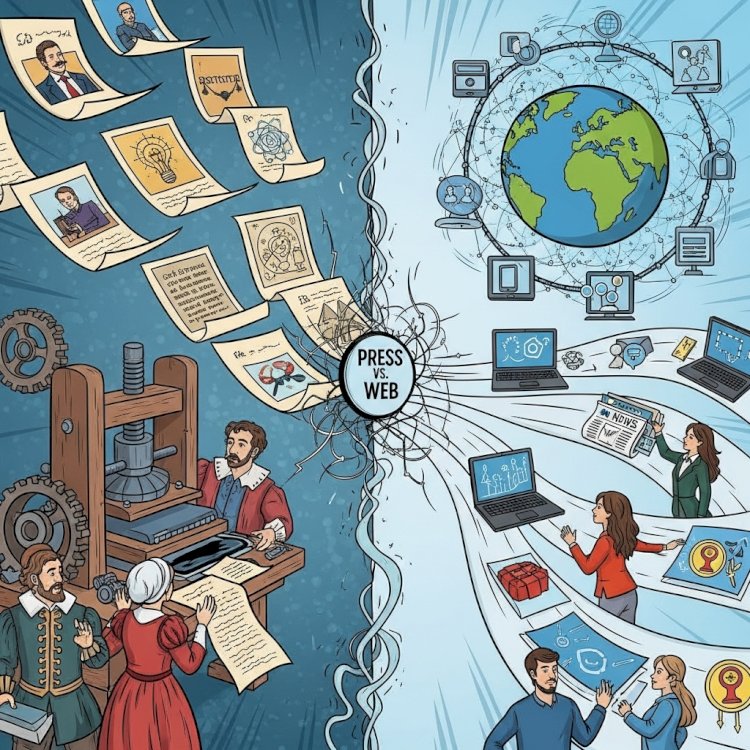
The most obvious difference is speed. The printing press's revolution unfolded over centuries. The internet's has occurred in a single generation. While the press enabled a 'one-to-many' model of communication, broadcasting a single text to a wide audience, the internet created a 'many-to-many' network where anyone can be a creator and distributor of information [37]. This decentralized, interactive model allows ideas - and misinformation - to spread globally in an instant.
The Nature of Disruption: Eisenstein vs. Shirky
The work of two media theorists helps frame the comparison. Historian Elizabeth Eisenstein, in The Printing Press as an Agent of Change, argued that the press caused a long, turbulent transition that fundamentally altered the conditions of knowledge itself, enabling the Reformation and the Scientific Revolution [42]. It standardized texts, preserved knowledge from corruption, and created the intellectual common ground necessary for modern thought.
Contemporary theorist Clay Shirky describes the internet's disruption in more chaotic terms. He argues that true revolutions break old systems faster than new ones can be built to replace them [40]. For Shirky, the internet has caused the collapse of traditional institutions (like newspapers) without a clear, stable alternative emerging. This creates a period of prolonged chaos where "nothing will work, but everything might," and core social bargains are imperiled [40].
Measuring the Upheaval
Applying our framework reveals the distinct nature of each upheaval:
- Political Instability: The printing press directly fueled the Protestant Reformation, a schism that led to over a century of brutal religious wars and the redrawing of Europe's political map. The internet has fueled revolutions like the Arab Spring and deepens polarization globally, but it has not (yet) resulted in a singular, continent-spanning military conflict of the same magnitude.
- Economic Transformation: The press created a new industry and new professions, but it did so within the existing pre-industrial economic framework. The internet has created the digital and gig economies, fundamentally challenging the 20th-century model of employment and the social contract built around it.
- Loss of Trust in Institutions: The press shattered the absolute authority of the Catholic Church, the most powerful institution in medieval Europe. The internet has eroded trust across a broader range of institutions - government, media, science, and finance - by decentralizing information and empowering alternative narratives, both true and false.
6. Conclusion: The Final Verdict?
So, which technology caused more social upheaval? The answer depends on the definition of 'more.'
The printing press caused a more foundational upheaval. It shattered a world of information scarcity controlled by a single clerical authority. By creating the very concept of a mass, literate public and enabling the standardization of knowledge, it laid the essential groundwork for the modern world: the nation-state, capitalism, modern science, and the ideal of an informed citizenry. Its impact was structural, deep, and permanent.
The internet's upheaval is defined by its unprecedented velocity, global scale, and the radical decentralization of creation and distribution. It has compressed time and space, empowered individuals on a global stage, and introduced a level of interactive chaos that the top-down print world never could. Its disruption is broader, faster, and continuously evolving, and we are still in the chaotic midst of its revolutionary transition.
Ultimately, the printing press appears to be the greater agent of social upheaval because it created the conditions for the modern world from a medieval one. It changed the fundamental structure of Western society. The internet, while profoundly disruptive, operates within the literate, globalized, and interconnected framework that the printing press first made possible. The press gave us a new map of the world; the internet is changing the speed at which we all move across it, often in conflicting directions.
References
- Defining Social Disruption
- The Printing Press and the Protestant Reformation
- Technological determinism - Wikipedia
- Social Upheaval: Definition, Examples, and Causes
- The information revolution is a myth - Aeon
- Measuring Social Change - University of Glasgow
- Political instability: a literature review - Cambridge University Press
- What Is Societal Collapse?
- What is Social Cohesion?
- The Gini Coefficient: Measuring Inequality
- 10 Signs of Societal Collapse
- Fragile States Index
- How to Measure Social Change
- The Printing Press and the Spread of Ideas
- How the Printing Press Changed the World
- The Printing Press: The History and Impact of a Game-Changing Invention
- Sociology of Technology
- How Johannes Gutenberg’s Printing Press Changed the World
- How did the printing press affect the Protestant Reformation?
- Pamphlet war - Wikipedia
- German Peasants' War - Wikipedia
- Literacy in Early Modern Europe
- The Role of the Printing Press in the Scientific Revolution
- Social Media and Political Polarization
- The Role of Social Media in the Arab Spring
- Social Media in the Arab Spring: The Case of Egypt
- The Gig Economy: Definition, Statistics & Examples
- A New Social Contract For The Digital Age
- The impact of social media on social movements
- Disinformation Campaigns
- The impact of social media on 21st century social movements
- Positive and Negative Effects of Social Media on Social Movements
- Digital divide - Wikipedia
- Digital divide persists, with a third of the world's population still offline
- One-third of the world’s population remains offline
- What is the Digital Divide?
- Printing Press vs. The Internet
- Media Revolutions and Societal Change
- Information dissemination - Wikipedia
- Newspapers and Thinking the Unthinkable
- Communication Technology and Society
- The Printing Press as an Agent of Change
What's Your Reaction?