Standardized Minds: Does Modern Education Suppress the Creative Instinct?
This comprehensive analysis explores the historical origins of standardized schooling, the psychological impact of high-stakes testing, and whether modern educational frameworks prioritize industrial compliance over human creativity.
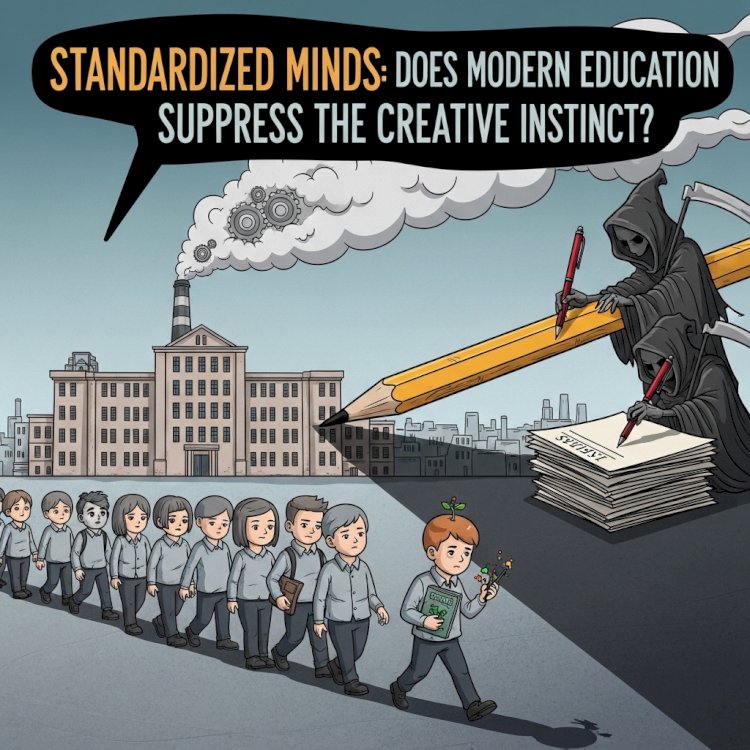
- Introduction
The question of whether the modern education system suppresses creativity in favor of standardized compliance is one of the most contentious debates in contemporary social science. As we move deeper into an era defined by rapid technological change and the need for innovative problem-solving, the structures of our schools remain remarkably similar to those established over a century ago. This analysis seeks to determine if the very architecture of our schooling system - designed for a different age - is actively hindering the cognitive flexibility required for the 21st century. By examining the historical genesis of the state-controlled school, the psychological toll of high-stakes assessment, and the success of alternative frameworks, we can begin to see the tension between the need for societal order and the biological drive for creative expression.
- The Historical Genesis of Standardized Schooling
To understand the current state of education, one must look back to the 18th and 19th centuries, specifically to the development of the Prussian Model of education. This system was not designed to foster individual genius or creative exploration; rather, it was a direct response to military defeats during the Napoleonic Wars. Prussian leaders required a citizenry that was reliable, unified, and, above all, obedient [1]. The goal was to produce soldiers who followed orders without question and subjects who would not challenge state authority [2].
This system featured a rigid, tiered structure. At the bottom was the Volksschulen, or People's Schools, attended by over 92% of the population. The curriculum here emphasized obedience, cooperation, and the rudiments of literacy, while intentionally discounting broader reading to prevent social dissatisfaction [1]. Meanwhile, the Akademiensschulen was reserved for a tiny elite, focusing on strategic thinking and command tasks [3]. This deliberate design was the first massive experiment in standardized schooling, creating a template for universal, compulsory attendance and national testing that persists today.
- The Industrial Revolution and the Factory Model
The rise of the Industrial Revolution further cemented this standardized approach. As economies shifted from agrarian to industrial, the demand for a disciplined, skilled workforce grew. The resulting structure is often referred to as the Factory Model of Education [4]. This model mirrors factory production lines: students are grouped by age (much like product batches), follow a bell-driven schedule, and are seated in orderly rows to minimize distraction and maximize efficiency [1].
In this industrial context, the teacher serves as a manager of materials and people, ensuring that students acquire basic technical skills and a strict ethos of duty and sobriety [3]. The focus transitioned from craftsmanship and localized knowledge to a centralized system of compliance. While this was effective for training machine operators in the 19th century, it created a lasting conflict between the need for consistency and the human need for individuality. Arguments for standardization emphasize consistency and a level playing field, yet critics argue it treats children as scores on a test rather than unique human beings [2], [4].
- The Psychological Impact of High-Stakes Testing
One of the primary mechanisms of standardized compliance in the modern era is the prevalence of high-stakes testing. These assessments carry severe consequences for students, teachers, and schools, often leading to a phenomenon known as Teaching to the Test [14]. When the measurement of learning becomes the sole objective of schooling, the quality of that learning inevitably suffers.
Research indicates that high-stakes testing results in a significant loss of creativity within the curriculum. A 2007 national study revealed that nearly 44% of school districts had cut instructional time for science, social studies, and the arts to focus on tested subjects like math and reading [13]. This environment discourages divergent thinking - the ability to generate multiple solutions - and instead prioritizes finding the single "right answer" [15]. Students effectively become "future test takers" rather than critical thinkers, as the fear of failure leads to risk aversion and a mechanical approach to learning [16].
- Stress, Anxiety, and the Creative Process
The psychological repercussions of this testing culture are profound. Studies have shown a direct correlation between high-stakes assessment and increased levels of stress and anxiety in both students and educators [20]. This pressure is toxic to the creative process, which requires a sense of psychological safety to explore unconventional ideas. When students are forced into a rigid, prescribed content path, their intrinsic motivation declines, leading to disengagement and a potential lifelong aversion to learning [14], [15].
Furthermore, standardized tests fail to account for individuals with Non-Standardized Minds. By ignoring differences in learning styles and abilities, the system pathologizes those who do not fit the mold. This is particularly evident when comparing traditional IQ-style tests to the Torrance Tests of Creative Thinking (TTCT). While traditional tests focus on convergent thinking, the TTCT measures Fluency, Flexibility, Originality, and Elaboration [23]. The modern focus on high-stakes assessment may be inadvertently suppressing these very skills, which are essential for innovation in any field [19], [21].
- Institutional Barriers to Creative Pedagogy
Even when teachers wish to foster creativity, they often face significant institutional barriers. Chief among these is a lack of Teacher Autonomy. There is a positive correlation between an educator’s freedom to make decisions and their ability to foster innovation in the classroom [24]. However, many teachers report feeling constrained by "lockstep" instructional programs and district standards that discourage novelty [27].
These constraints are often embedded in the curriculum itself. Many modern curricula are designed to be Teacher-Proof, meaning they are so scripted and rigid that they require little input or creativity from the educator [28]. While intended to ensure consistency and close achievement gaps, these programs can stifle critical thinking. A 2013 survey found that 25% of parents and 21% of educators identified standardized testing as the single greatest obstacle to creativity in the classroom [24], [25]. The "single-minded pursuit of the right answer" in educational policy has created a culture where experimentation is viewed as a liability rather than an asset.
- School Administration vs. Creative Innovation
The role of administration is critical in determining whether a school fosters or hinders creativity. Traditional leadership often focuses on organization, management, and structure - traits that can inadvertently crush innovation [26]. In contrast, Creative Leadership involves treating challenges as opportunities and fostering an environment of respect, solidarity, and open communication [29].
Administrators who successfully promote innovation often balance academic rigor with meaningful relationships and hands-on learning. They view failure as a First Attempt In Learning (FAIL) rather than a terminal result [32]. When leadership supports project-based learning and flexible professional development, it empowers both staff and students to take risks. Unfortunately, institutional policies and crowded classes frequently force administrators back into a management-only role, further reinforcing the status quo of compliance [33], [34].
- Alternative Educational Frameworks: The Finnish Model
Looking toward international examples, the Finnish education system offers a compelling alternative to the standardized compliance model. Finland has gained global recognition for its focus on holistic development rather than high-stakes testing [35]. One of the core tenets of the Finnish approach is Play-Based Learning, which is integrated into the curriculum from an early age to stimulate curiosity and problem-solving skills [36].
Finnish schools also utilize Phenomenon-Based Learning, where different subjects are integrated around a real-world theme. This encourages students to make connections across disciplines, fostering the type of complex critical thinking that standardized tests often miss [37]. Most importantly, Finland grants its teachers immense autonomy and treats teaching as a high-status profession. By minimizing standardized testing and focusing on student well-being and equity, Finland has created a system that consistently ranks among the best in the world for both academic achievement and student happiness [38].
- Montessori vs. Traditional Outcomes
Another well-established alternative is Montessori Education, a child-centered approach that emphasizes independence and hands-on learning. Unlike traditional schools, Montessori classrooms often feature mixed-age groups and long blocks of uninterrupted work time, allowing students to follow their interests at their own pace [39].
Research consistently shows that Montessori students outperform their peers in traditional settings, particularly in areas of Executive Function, such as impulse control and planning [40]. A 2017 study found that Montessori students scored higher on academic tests while also demonstrating superior social skills and a greater love for learning [45]. The emphasis on Intrinsic Motivation - the internal drive to learn for the sake of learning - contrasts sharply with the extrinsic rewards (grades and scores) of the standardized system. Furthermore, long-term studies suggest that former Montessori students report higher levels of general well-being and career satisfaction in adulthood [46], [47].
- The Effectiveness of Project-Based Learning
Project-Based Learning (PBL) is an inquiry-based framework that has shown remarkable success in bridging the gap between rigor and creativity. In a PBL setting, students investigate real-world problems through long-term projects, making their education feel relevant and engaging [41]. A meta-analysis of 20 years of research concluded that PBL significantly improves learning outcomes and thinking skills compared to traditional rote memorization [43].
Two major randomized controlled trials in the United States found that PBL students outperformed their peers in traditional classrooms by 8 to 10 percentage points on AP tests [42]. These gains were consistent across socioeconomic groups, proving that creative pedagogy is not just for the elite but is an effective tool for equity [44]. PBL increases student engagement and self-efficacy, turning passive learners into active investigators who are better prepared for the unpredictable demands of the future workforce [41], [51].
- Conclusion
The evidence suggests that while the modern education system was designed to provide order and basic skills during the industrial era, it is now poorly suited to the needs of a creative economy. The heavy reliance on high-stakes testing and the suppression of teacher autonomy have created a culture of standardized compliance that often comes at the expense of student well-being and creative potential. However, the success of the Finnish system, Montessori schools, and Project-Based Learning proves that a different path is possible.
To move forward, we must transition away from the factory model and toward a system that values Divergent Thinking, emotional intelligence, and real-world application. Standards should serve as a baseline, not a ceiling. By fostering environments that encourage risk-taking and individuality, we can ensure that the next generation is not just compliant, but capable of the innovation required to solve the complex problems of our time.
References
- The Prussian Education System - youtube.com
- Standardization vs. Individuality - stemiteracy.org
- Historical Roots of Schooling - cardinalinstitute.com
- The Factory Model - medium.com
- Education Debates - reddit.com
- Schooling Structures - drossbucket.com
- History of Education - britannica.com
- Impact on Teens - secureteen.com
- Modern Education Trends - ehl.edu
- Standardization in Schools - schoolworkslab.org
- Testing Pressures - edweek.org
- Educational Philosophy - krinstitute.org
- High-Stakes Testing Data - ed.gov
- Teaching to the Test - gadflyonthewallblog.com
- Psychological Impacts - stthomas.edu
- Creativity in Education - vye.agency
- Testing and Creativity - quora.com
- Art Education and Testing - arteducators.org
- Creative Skills - jamestaylor.me
- Stress and Student Motivation - nih.gov
- Cognitive Impact of Schooling - remotesparks.com
- High-Stakes Research - taylorandfrancis.com
- Torrance Tests of Creative Thinking - wikipedia.org
- Teacher Autonomy Studies - awej.org
- Institutional Barriers - teachers.institute
- Leading for Thinking - leadingforcreativethinking.org
- Teacher Constraints - urmia.ac.ir
- Curriculum Standardization - researchgate.net
- School Leadership and Innovation - scirp.org
- Creative Pedagogy Barriers - ase.org.uk
- The Scripted Curriculum - kappanonline.org
- Innovative Leadership - lindsaymalanga.com
- Administration and Creativity - ijpes.com
- Educational Musings on Creativity - educationalmusings.com
- Finnish Education Model - finlandeducationhub.com
- Creativity in Finland - ccefinland.org
- Phenomenon-Based Learning - gioct.org
- Finnish System Outcomes - jyu.fi
- Montessori Principles - intiwasischool.com
- Montessori vs Traditional - reveremontessori.com
- Project-Based Learning - edutopia.org
- PBL Research Trials - lucasedresearch.org
- Effectiveness of PBL - pblworks.org
- Equity in PBL - tandfonline.com
- Montessori Academic Performance - nih.gov
- Long Term Montessori Success - nwciowa.edu
- Social Emotional Outcomes - researchgate.net
- Creativity and Curriculum - taylorandfrancis.com
- The Future of Schooling - medium.com
- PBL and Higher Order Thinking - edutopia.org
- Engagement Through Projects - pblworks.org
What's Your Reaction?