The Global Governance Dilemma: Can a World Government Avoid Tyranny?
The idea of a global government sparks both hope for world peace and fear of ultimate tyranny. This article explores whether a world government can exist without becoming authoritarian, examining historical precedents, political philosophies, and the institutional safeguards needed to protect liberty on a global scale.
1. Introduction: A Perennial Question for a Globalized World
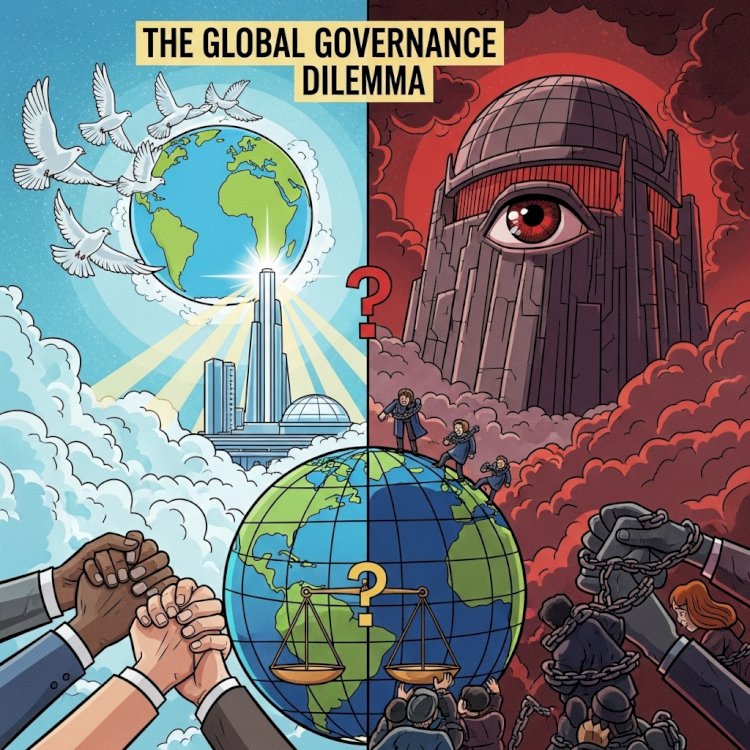
The concept of a world government has captivated thinkers for centuries. To its proponents, it represents the ultimate solution to war, climate change, pandemics, and global inequality - a unified authority capable of addressing challenges that transcend national borders. To its critics, it is a dystopian nightmare, a path to a global tyranny from which there is no escape. This dichotomy raises one of the most profound political questions of our time: can a global government exist without becoming authoritarian?
The concentration of power is a well-documented risk. History is replete with examples of centralized authorities that devolved into oppressive regimes. Yet, the increasing interconnectedness of our world demands greater international cooperation. This article delves into this complex dilemma by examining historical attempts at supranational governance, exploring philosophical blueprints for a just world order, analyzing the institutional designs necessary to prevent tyranny, and confronting the formidable socio-cultural and technological challenges of the 21st century.
2. Lessons from History: Supranationalism and its Pitfalls
Before designing a future global government, we must learn from the past. History offers crucial case studies on the promises and perils of governance beyond the nation-state, from failed international bodies to the most ambitious supranational experiment to date.
The Ghost of the League of Nations
The first major attempt at a worldwide intergovernmental organization was the League of Nations, founded in 1920 with the noble goal of maintaining global peace [6]. However, its failure to prevent the aggression of the Axis powers in the 1930s serves as a stark warning. The League's collapse can be attributed to several key flaws: it lacked the membership of major powers like the United States, it had no armed forces to enforce its resolutions, and the self-interest of its dominant members consistently undermined its authority [5, 9]. The League was an intergovernmental body where powerful states could simply choose to ignore or leave the organization, demonstrating that a global authority without meaningful power or universal buy-in is ultimately ineffective [6].
The European Union: A Living Laboratory
The European Union (EU) stands as the world's most developed example of supranationalism, where member states delegate or pool sovereignty in a higher authority [15, 17]. Unlike the League, the EU has powerful institutions, such as the Court of Justice, whose rulings can overturn national laws [17]. However, the EU's journey has also exposed a fundamental challenge known as the “democratic deficit” [1]. This term describes a perceived gap between the EU's powerful institutions and the ability of ordinary citizens to influence their decisions [2]. Voter turnout in European Parliament elections has historically been low, and many citizens feel disconnected from the complex bureaucracy in Brussels [1]. The German Constitutional Court even identified a “structural democratic deficit,” noting that the EU’s decision-making process often resembles an international organization rather than a truly representative government [2]. While treaties from Maastricht to Lisbon have attempted to address this by empowering the European Parliament, the EU continues to grapple with questions of accountability and legitimacy, providing a critical lesson for any future global government [1].
Echoes of Ancient Empires
Looking further back, ancient empires offer a more sobering perspective on centralized power. Empires from Rome to Imperial China developed sophisticated systems of governance, law, and bureaucracy to manage vast territories [8, 22]. However, their power was almost always absolute and centralized in a single ruler - a pharaoh, emperor, or king - who often claimed divine authority [8]. While Rome developed a complex legal framework that influenced modern law, its transition from a republic to an empire illustrates the seductive and often violent consolidation of power [22]. These historical precedents show that large-scale governance has traditionally relied on hierarchical and authoritarian structures, a model that stands in direct opposition to modern democratic ideals.
3. Philosophical Blueprints for a Non-Authoritarian World Order
The fear of a global tyranny has led philosophers and political theorists to develop models for a world government that safeguard liberty. These blueprints reject a monolithic world state in favor of more nuanced, decentralized, and democratic structures.
Realism vs. Liberalism: A Fundamental Divide
The debate over global governance is rooted in two competing theories of international relations. Political Realism views the world as an anarchic system where self-interested states constantly compete for power [30]. From a realist perspective, a world government is not only unfeasible but undesirable, as it would require states to surrender their sovereignty, potentially leading to a global hegemon or an inescapable tyranny [33]. In contrast, Liberalism offers a more optimistic view, emphasizing the potential for cooperation through international institutions, law, and shared democratic values [31, 32]. Liberals believe that complex interdependence can foster peace and that robust global governance can solve collective problems without erasing national identity [31].
Kant's Warning: A Federation, Not a World State
Over two centuries ago, the philosopher Immanuel Kant, in his essay “Perpetual Peace,” offered a foundational vision for global order. He argued that lasting peace required a “federation of free states” committed to resolving disputes through law [27]. Crucially, Kant argued against a single world government, which he believed would inevitably become a “soulless despotism” due to its immense scale and the difficulty of administering justice across diverse cultures. His proposal was for a voluntary league of republics, a model that has profoundly influenced modern theories of global governance.
World Federalism and Cosmopolitan Democracy
Building on Kantian ideas, World Federalism proposes a democratic global government structured like a national federation [24, 26]. In this model, the world government would have authority over strictly defined global issues like security and environmental protection, while member nations would retain sovereignty over all other matters. This division of power is governed by the principle of subsidiarity, which holds that decisions should be made at the lowest, most local level possible [28].
Similarly, Cosmopolitan Democracy advocates for extending democratic principles to the global stage, creating a system of “global governance without world government” [23, 25]. This model emphasizes multiple, overlapping layers of governance and seeks to democratize existing international organizations like the United Nations, perhaps by creating a directly elected world parliament. Both theories prioritize decentralization, constitutional limits on power, and the protection of human rights as essential safeguards against authoritarianism [24, 25].
4. Institutional Safeguards Against Global Tyranny
A non-authoritarian global government cannot rely on good intentions alone; it must be built upon a robust institutional framework designed to limit power, ensure accountability, and protect liberty.
Global Constitutionalism and Checks and Balances
The most fundamental safeguard is Global Constitutionalism, the idea that a global government must be bound by a constitution that defines and limits its powers while guaranteeing fundamental rights [35, 36]. Central to this concept is the principle of checks and balances, which distributes power among separate branches of government - typically legislative, executive, and judicial [37]. This separation ensures that no single entity can accumulate enough power to rule unilaterally [39]. On a global scale, this could mean a world parliament to pass laws, an executive body to implement them, and an independent judiciary to interpret them, with each branch having the power to constrain the others.
The Role of International Law and Courts
A global rule of law requires impartial judicial bodies. The International Court of Justice (ICJ) serves as a model, settling legal disputes between states [43]. However, its jurisdiction relies on the consent of states, and it lacks a mechanism to enforce its rulings, meaning powerful nations can and do ignore its decisions [44]. A true global government would require a more powerful judiciary with compulsory jurisdiction to hold both states and the global authorities themselves accountable to the law.
Decentralization and Polycentric Governance
To counter the risk of over-centralization, many theorists advocate for decentralized models. Polycentric Governance envisions a system of multiple governing bodies at different scales, from local to global, operating both independently and interdependently [40]. This distribution of authority creates resilience and prevents a single point of failure or control. In a highly decentralized world, citizens could even “vote with their feet” by moving away from oppressive jurisdictions, thereby depriving tyrannical regimes of resources and legitimacy [40]. Such a system makes widespread oppression far more difficult to achieve than under a single, monolithic global state.
Furthermore, designing a fair global electoral system presents immense challenges. A system based purely on population could lead to a “tyranny of the majority,” where a few highly populous nations dominate decision-making [47]. Systems that give disproportionate weight to smaller states, however, risk being seen as undemocratic. Balancing fair representation with the protection of minority rights is a critical institutional hurdle that must be overcome [48].
5. Modern Challenges in the 21st Century
Any discussion of global government today must confront a new set of complex challenges that could either necessitate or undermine such a project.
Cultural Diversity and Universal Rights
A global government would inevitably face the deep-seated tension between cultural relativism and universal rights. While the Universal Declaration of Human Rights posits that all individuals share inherent rights [52], some argue that rights and values are culturally determined [53]. A global authority seeking to enforce universal standards on issues like women's rights or freedom of speech could be accused of cultural imperialism, sparking resistance and undermining its legitimacy. At the same time, allowing cultural relativism to justify human rights abuses would defeat one of the primary moral arguments for a global government [54]. Navigating this divide requires a delicate balance that respects cultural diversity while upholding a core, non-negotiable set of human rights.
Technology: A Tool for Liberation or Control?
Technology presents a dual-edged sword. While the internet can connect global civil society and promote transparency, it also enables digital authoritarianism [55]. The rise of AI-powered mass surveillance, facial recognition, and social credit systems provides states with unprecedented tools for social and political control [56]. An authoritarian global government armed with such technology could create a surveillance state of unimaginable scope and power. China and other nations are already exporting these technologies to like-minded regimes, creating a global market for the tools of repression [57]. Ensuring that digital governance enhances freedom rather than enabling control is perhaps the single greatest technological challenge.
Global Inequality and Legitimacy
Our world is marked by vast economic inequality. The fact that a handful of individuals own as much wealth as the poorest half of the world’s population creates profound instability and injustice [59, 61]. A global government that fails to address this disparity, or worse, reinforces it, would lack legitimacy in the eyes of the majority of the world's population. Illicit financial flows, tax avoidance by multinational corporations, and the disempowerment of workers are systemic problems that erode trust and fuel conflict [62]. Any viable global government must be built on a foundation of economic fairness and shared prosperity.
6. Conclusion: A Feasible Dream or a Utopian Nightmare?
So, can a global government exist without becoming authoritarian? The answer is a qualified and cautious yes, but not in the form of a centralized, all-powerful world state. The lessons of history, the insights of political philosophy, and the realities of our modern world all point in the same direction: a monolithic global government would almost certainly become a tyranny, just as Kant predicted.
However, a different path may be possible. A non-authoritarian global system would have to be fundamentally decentralized, federal in structure, and rigorously bound by the principle of subsidiarity. It would require a robust global constitution with ironclad checks and balances, an independent judiciary, and steadfast protection for universal human rights. Its structure would more closely resemble a network of accountable institutions - or a system of global governance [29] - rather than a single, sovereign government.
The challenges remain immense. Overcoming cultural divisions, taming the authoritarian potential of technology, and building a more equitable economic system are monumental tasks. Yet, as global crises continue to mount, the need for effective, democratic, and accountable global cooperation has never been more urgent. The goal is not to build a world government that erases nations and cultures, but to construct a framework of global governance that can manage shared problems while ensuring that power remains limited, accountable, and ultimately, in the service of human freedom.
References
- europa.eu
- wikipedia.org
- ecpr.eu
- lse.ac.uk
- historyonthenet.com
- wikipedia.org
- rauias.com
- historyhit.com
- gcsehistory.com
- stanford.edu
- wikipedia.org
- sparknotes.com
- nycourts.gov
- pressbooks.pub
- alevelpolitics.com
- reddit.com
- port.ac.uk
- euroculturer.eu
- ebsco.com
- medium.com
- weebly.com
- oerproject.com
- wikipedia.org
- polsci.institute
- danielearchibugi.org
- wikipedia.org
- wikipedia.org
- wikipedia.org
- wikipedia.org
- polsci.institute
- polsci.institute
- e-ir.info
- studydog.co.uk
- planksip.org
- planksip.org
- cambridge.org
- civicsforlife.org
- britannica.com
- cornell.edu
- substack.com
- youtube.com
- icj-cij.org
- wikipedia.org
- guide-humanitarian-law.org
- civicus.org
- heritage.org
- quora.com
- un.org
- globaltimes.cn
- pubadmin.institute
- forus-international.org
- globalissues.org
- fiveable.me
- lawteacher.net
- csis.org
- gcsp.ch
- cnas.org
- freedomhouse.org
- fpif.org
- manchester.ac.uk
- imf.org
- un.org
- undp.org
- iipa.org.in
- digitalcivilizationbuilders.com
- researchgate.net
What's Your Reaction?