Of Concrete and Canaries: How Urbanization is Reshaping Biodiversity in the World’s Metropolises
An in-depth analysis of how global urbanization impacts biodiversity, exploring habitat loss, species adaptation, and the innovative urban planning solutions being used.
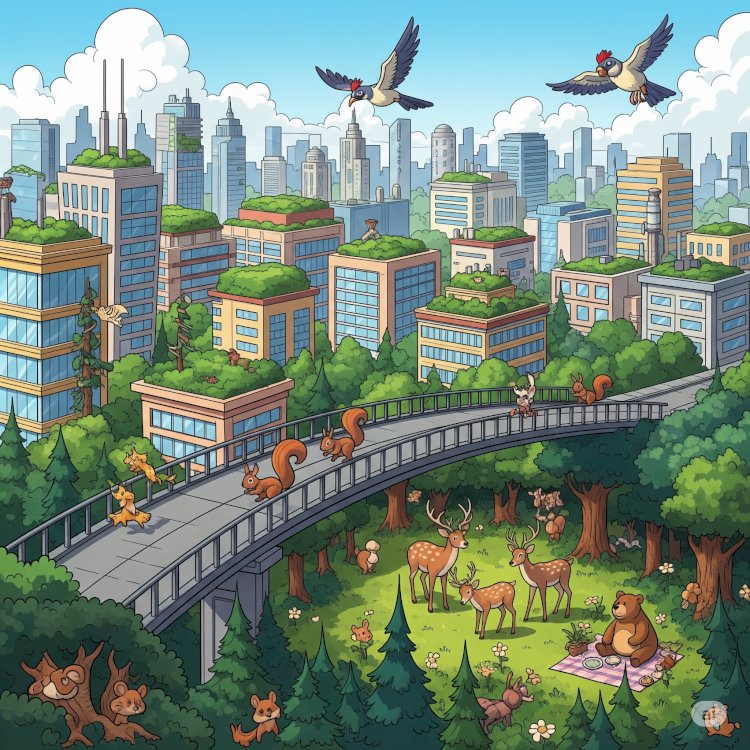
The relentless march of human progress in the 21st century is written in steel, glass, and concrete. More than half of the world's population now resides in urban areas, a figure projected by the United Nations to climb to nearly 70 percent by 2050. This great migration has forged megacities that are hubs of innovation, culture, and economic power. Yet, beneath the hum of traffic and the glare of city lights, a profound ecological drama is unfolding. The expansion of our urban footprints is fundamentally altering the natural world, creating both immense challenges and surprising opportunities for biodiversity. The central question we face is no longer if cities impact nature, but how this intricate relationship works and what it means for the future of life on Earth, including our own.
To understand this complex interplay, we must look beyond a simple narrative of destruction. While urbanization is a primary driver of habitat loss, it also creates novel ecosystems where evolution is happening in real-time. Some species vanish, while others adapt with remarkable ingenuity, becoming truly urban creatures. This article aims to systematically investigate the multifaceted impact of urbanization on biodiversity in major metropolitan areas around the globe. We will examine the patterns of urban growth, dissect the direct ecological consequences, explore the fascinating resilience of urban wildlife, and draw lessons from cities that are actively trying to reconcile their development with the natural world.
In this article, we will explore this topic through the following key areas:
Table of Contents
-
Urbanization Trends and Patterns
-
Direct Impacts on Biodiversity
-
Adaptation and Resilience of Urban Wildlife
-
Case Studies from Global Cities
-
Mitigation Strategies and Urban Planning Solutions
1. Urbanization Trends and Patterns
The story of urbanization is a story of accelerating transformation. While cities have existed for millennia, the scale and speed of their growth in the contemporary era are without precedent. This global phenomenon is driven by a confluence of factors, including economic opportunities, technological advancements, and demographic shifts. According to UN Habitat reports, the most rapid urbanization is now occurring in Asia and Africa, regions that are projected to account for 90% of the world's urban population growth over the next three decades. This growth materializes on the landscape not just as denser urban cores, but as sprawling metropolitan regions that consume vast tracts of land.
The spatial patterns of this expansion are critical to its ecological impact. Historically, many cities grew concentrically from a central point. Today, however, urban growth is often more chaotic and diffuse. A common pattern is urban sprawl, characterized by low-density, car-dependent development that leaps across the landscape in a patchy, inefficient manner. This form of growth is particularly damaging as it maximizes the amount of land converted for a given population. Another pattern is linear expansion, where development follows major transportation arteries like highways and railways, creating long, thin tendrils of urbanity that cut deep into rural and natural areas.
This process is fundamentally one of land-use change. Fertile agricultural lands, dense forests, and productive wetlands are systematically paved over, replaced by impervious surfaces like asphalt and concrete. This conversion is not merely a one-for-one trade; it represents a profound alteration of local hydrology, climate, and biogeochemical cycles. Satellite data and land-use change maps reveal a stark picture of this global conversion, showing expanding red zones of urban development encroaching on the green of natural landscapes. The creation of these vast, human-dominated environments sets the stage for a cascade of ecological consequences, permanently altering the conditions for life for countless species.
2. Direct Impacts on Biodiversity
The most immediate and severe consequence of urban expansion is habitat loss. When a forest is cleared for a housing development or a wetland is filled for an industrial park, the homes, food sources, and breeding grounds for innumerable species are obliterated. This raw destruction is the primary driver of local extinctions and population decline in urbanizing regions. For species with highly specific habitat requirements, known as specialists, this loss is often a death sentence. They are unable to find alternative environments that meet their unique needs for food, shelter, or reproduction.
Equally damaging, though perhaps more insidious, is the phenomenon of habitat fragmentation. Urban development rarely erases an entire ecosystem at once. Instead, it carves it into smaller, disconnected pieces. Roads, buildings, and fences act as barriers, creating isolated "islands" of natural habitat surrounded by a hostile sea of urban infrastructure. This fragmentation has several devastating effects. It restricts the movement of animals, preventing them from finding mates, foraging for food, or migrating. This isolation can lead to a reduction in genetic diversity within the trapped populations, making them more vulnerable to disease and environmental changes. An apt analogy is to imagine a magnificent, continuous tapestry of an ecosystem being cut by scissors into dozens of small, frayed squares, with each square losing its connection to the whole and slowly unraveling at the edges.
Beyond the physical transformation of the land, cities introduce a host of other stressors. The urban heat island effect, where temperatures in cities are significantly higher than in surrounding rural areas, can alter plant flowering times and disrupt insect life cycles. Artificial light at night can disorient migratory birds, interfere with the hunting patterns of nocturnal predators, and disrupt the reproductive cycles of amphibians. Chronic noise pollution from traffic and industry can mask the communication calls of birds and frogs, making it difficult for them to attract mates or defend territories. Finally, chemical pollution from industrial discharge, vehicle emissions, and stormwater runoff introduces toxins into the soil and water, harming both plant and animal life and accumulating in the food web. Together, these direct impacts create a formidable gauntlet of challenges that most native species are ill-equipped to survive.

3. Adaptation and Resilience of Urban Wildlife
While the narrative of urbanization is often one of ecological loss, it is also a story of surprising resilience and adaptation. Cities are not biological deserts; they are novel ecosystems where the intense pressures of the urban environment drive rapid behavioral and even evolutionary changes in certain species. The organisms that succeed in this new reality are often referred to as "urban adapters" or "urban exploiters." These are typically generalist species, possessing flexible diets, high reproductive rates, and a notable tolerance for human presence.
The strategies for survival are as varied as the species themselves. Behavioral plasticity - the ability of an organism to change its behavior in response to environmental changes - is a key trait. Raccoons in North America have become masters of urban foraging, learning to open complex garbage bin locks. Peregrine falcons, once driven to near extinction by pesticides, have made a remarkable comeback by nesting on the ledges of skyscrapers, which serve as artificial cliffs, and preying on the abundant pigeons. In many cities, birds have been observed singing at a higher pitch or at night to ensure their calls can be heard above the din of traffic. Some species of lizards in Puerto Rico have been documented evolving larger toe pads to better grip smooth, man-made surfaces like concrete and glass.
These adaptations demonstrate that urban environments are powerful selective forces. The species that thrive are those that can exploit the new resources cities offer, such as discarded food, artificial water sources, and the warmth generated by buildings. Coyotes, once animals of the open plains, now navigate the suburban landscapes of cities like Chicago and Los Angeles, having adjusted their diets and activity patterns to avoid humans. Red foxes have become a common sight in London, raising their young in dens under garden sheds. This process creates a unique "urban biome," characterized by lower overall species diversity but often high abundances of a few highly successful species. The study of this urban wildlife provides crucial insights into ecological resilience and the capacity of life to find a foothold in even the most human-altered landscapes.
4. Case Studies from Global Cities
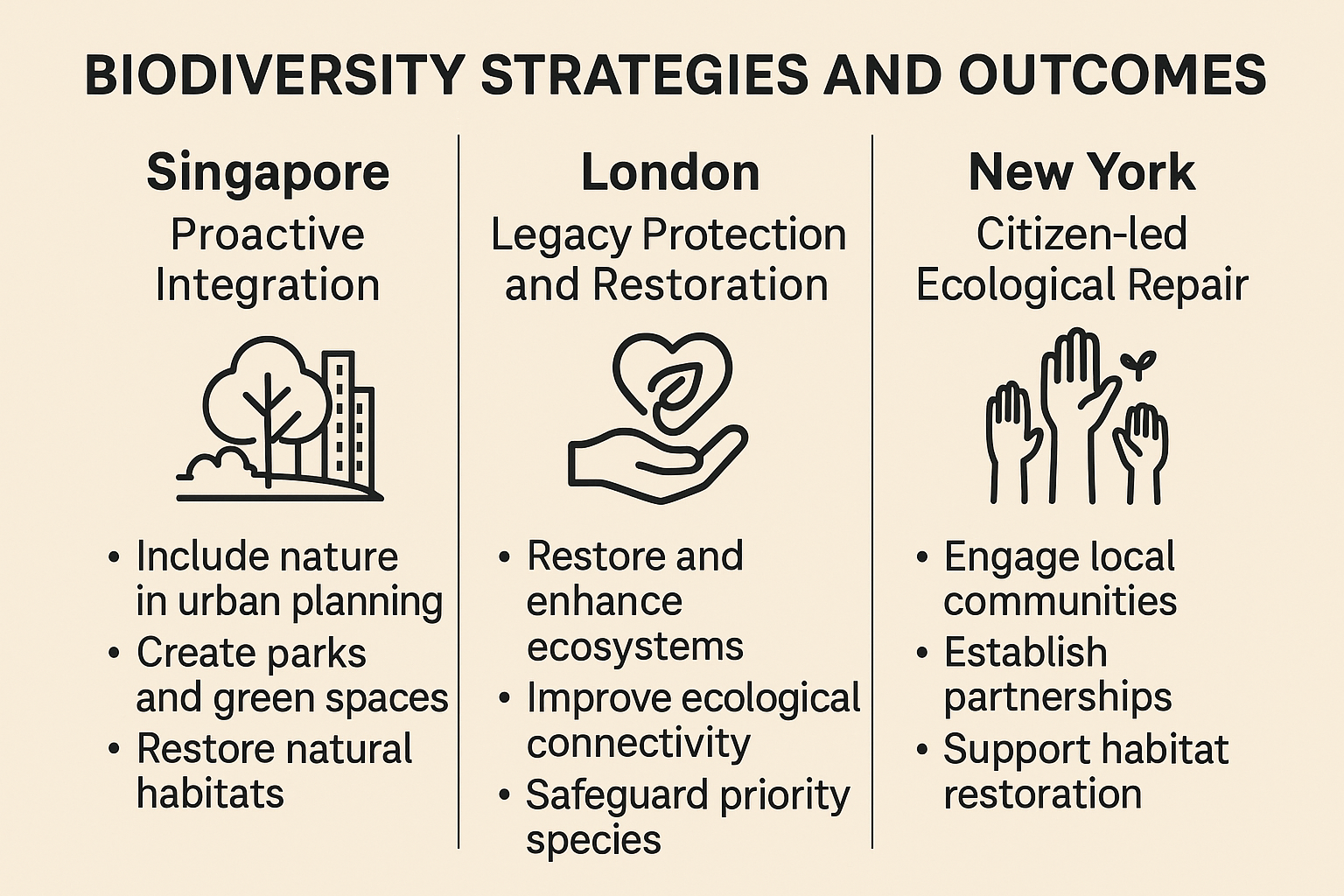
Examining specific metropolitan areas provides a grounded understanding of how different approaches to urban development yield vastly different outcomes for biodiversity. The cities of Singapore, London, and New York offer compelling, contrasting case studies.
Singapore stands as a remarkable example of proactive ecological integration. Despite being one of the most densely populated nations on Earth, it has pursued a vision of a "City in a Garden." Through deliberate, long-term planning, Singapore has woven a rich tapestry of green spaces into its urban fabric. The Park Connector Network, a series of green corridors totaling over 300 kilometers, links major parks, nature reserves, and residential areas. This network facilitates the movement of wildlife, such as the smooth-coated otter, which has made a celebrated return to the city's waterways. Furthermore, Singapore's "skyrise greenery" incentives have led to the proliferation of green roofs and vertical gardens, creating new habitats on the very surfaces of buildings. This approach demonstrates that high-density living and rich biodiversity are not mutually exclusive if nature is treated as essential infrastructure.
London, a much older and more sprawling metropolis, showcases a different model of urban nature. Its biodiversity is supported by a vast mosaic of habitats: royal parks, private gardens, extensive canal systems, cemeteries, and railway embankments. While fragmentation is a significant challenge, targeted restoration projects have yielded spectacular results. The London Wetland Centre, a 105-acre reserve created from four disused Victorian reservoirs, is a prime example. It now hosts nationally important populations of birds like the gadwall and shoveler, and serves as a vital refuge for amphibians, bats, and dragonflies. London's experience highlights the immense potential for ecological restoration within existing urban footprints and the value of protecting its patchwork of legacy green spaces.
New York City offers a lesson in the resilience of nature and the power of citizen-led restoration. While Central Park is globally famous as an urban oasis and a critical stopover for migratory birds on the Atlantic Flyway, biodiversity initiatives are flourishing throughout the five boroughs. The Billion Oyster Project is a large-scale effort to restore a keystone species to New York Harbor. Oysters are ecosystem engineers; they filter water, and their reefs provide complex habitat for hundreds of other species. By engaging tens of thousands of students and volunteers, the project is not only rebuilding an ecosystem but also fostering a powerful sense of environmental stewardship. This case illustrates how even in the most hardened of urban environments, strategic interventions can begin to heal historical ecological damage and re-engage citizens with the natural world around them.
5. Mitigation Strategies and Urban Planning Solutions
Faced with the profound ecological consequences of urbanization, cities around the world are increasingly adopting innovative strategies to mitigate harm and actively foster biodiversity. These solutions move beyond simply setting aside parks and recognize that nature must be integrated throughout the urban matrix. This new paradigm is often framed around the concept of "green infrastructure," a network of natural and semi-natural areas designed and managed to deliver a wide range of ecosystem services.
A cornerstone of this approach is the creation of ecological corridors. These are linear strips of habitat - such as riverbanks, railway verges, or purpose-built greenways - that connect larger, fragmented patches of nature. By providing "wildlife highways," these corridors allow animals to move safely between populations, increasing genetic exchange and resilience. This principle is mathematically supported by the species-area relationship in island biogeography, often expressed as . In this formula, represents the number of species, is the habitat area, and and are constants. The formula shows that larger and better-connected areas (a larger effective 'A') can support a greater number of species ('S'). Corridors effectively increase the size of 'A' by linking isolated patches.
Another powerful tool is the implementation of green roofs and living walls. These not only help to mitigate the urban heat island effect and manage stormwater but can also provide crucial habitats for pollinators like bees and butterflies, as well as nesting sites for birds. When designed with native plant species, they can become valuable stepping-stones in the urban ecological network.
At a policy level, cities are adopting Biodiversity-Sensitive Urban Design (BSUD), which embeds biodiversity considerations into the earliest stages of the planning process. This might involve mandating the preservation of mature trees, requiring the use of native species in landscaping, or designing lighting systems that minimize ecological disruption. Some progressive cities are even experimenting with "urban rewilding," where certain areas are intentionally managed to allow natural processes to take over, creating more complex and self-sustaining ecosystems. These strategies require collaboration between ecologists, landscape architects, urban planners, and policymakers, all working toward the common goal of building cities where both people and nature can thrive. This represents a fundamental shift from viewing cities and nature as separate entities to envisioning them as a single, integrated, and mutually supportive system.
Conclusion
The rapid global expansion of metropolitan areas represents one of the most significant ecological transformations of our time. As we have seen, the construction of cities directly displaces and fragments natural habitats, introducing a suite of pressures from pollution to altered microclimates that drive biodiversity loss. Yet, this is not the end of the story. Amidst the concrete and steel, a new urban ecology is emerging. Resilient and adaptive species are carving out niches, demonstrating the tenacity of life in these novel ecosystems.
The critical insight from this analysis is that the future of urban biodiversity is not predetermined; it is a choice. Through the case studies of Singapore, London, and New York, we see that deliberate planning, ecological restoration, and community engagement can make a profound difference. By embracing strategies like green infrastructure, ecological corridors, and biodiversity-sensitive design, we can move from a model of development that simply consumes nature to one that actively integrates and regenerates it. Building greener, more ecologically resilient cities is not a luxury, but a necessity for the health of our planet and the well-being of the billions who call cities home. The challenge is to build the urban world of tomorrow not as a replacement for nature, but as its partner.
What's Your Reaction?