The Double-Edged Sword: Navigating Job Security, Benefits, and Career Growth in the Gig Economy
The rise of the gig economy represents one of the most significant transformations in the labor market of the 21st century. Heralded by its proponents as a gateway to unprecedented flexibility and entrepreneurial freedom, it is simultaneously critiqued by others as a mechanism that institutionalizes precarity and dismantles the hard-won social safety nets of the 20th century. This new paradigm of work, powered by digital platforms that connect service providers with consumers on a task-by-task basis, fundamentally redefines the relationship between a worker and their work. It challenges our traditional understanding of what a "job" is, moving from a stable, long-term relationship with a single employer to a fluid series of short-term, transactional engagements.
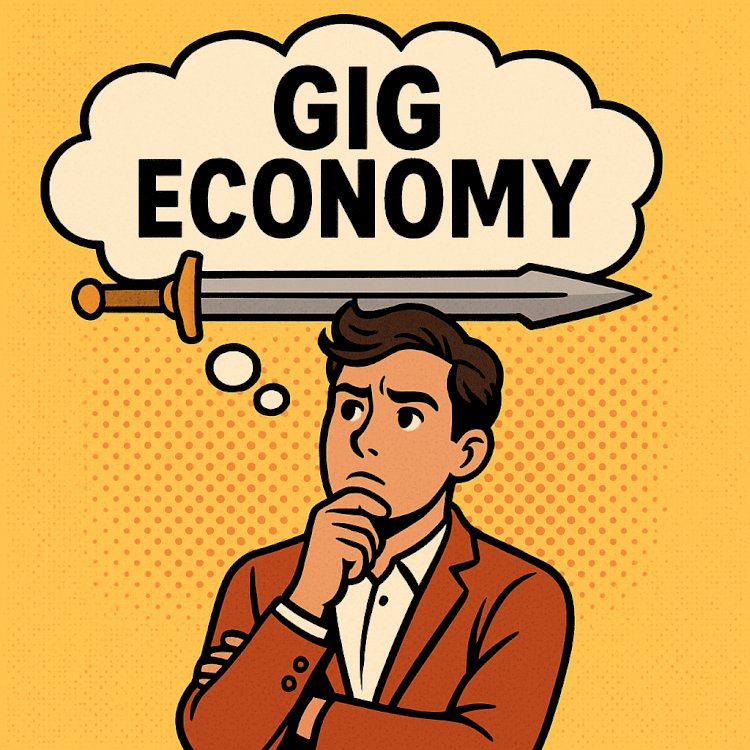
The central question this article addresses is: How does the gig economy affect job security, benefits, and long-term career development for workers? To answer this, we must move beyond simplistic narratives of either empowerment or exploitation. The reality of gig work is a complex tapestry woven from threads of autonomy and insecurity, opportunity and instability. It is an economic model that presents a different calculus of risk and reward than traditional employment, with profound implications for individual workers, social structures, and public policy. In this article, we will explore this topic through the following key areas, providing a systematic investigation into the multifaceted societal impacts of this evolving mode of labor.
Table of Contents
-
Understanding the Gig Economy
-
Impacts on Job Security and Worker Benefits
-
Long-Term Career Development and Skill Growth
-
Worker Experience and Perspectives
-
Policy, Legal, and Institutional Responses
1. Understanding the Gig Economy
At its core, the gig economy refers to a labor market characterized by the prevalence of short-term contracts or freelance work as opposed to permanent, salaried jobs. It operates through digital platforms—such as Uber, DoorDash, Instacart, Upwork, and Fiverr—that act as intermediaries, matching the supply of and demand for paid labor. What distinguishes this modern iteration of freelance work is the algorithmic management and the scale at which these platforms operate. A worker is no longer just a self-employed professional but is often managed, paid, and evaluated through an application on their smartphone.
The fundamental distinction between gig work and traditional employment lies in the nature of the employment relationship. Traditional employment is built on a model of mutual obligation: the employee provides their labor and loyalty in exchange for a predictable salary, a suite of benefits, legal protections, and a degree of job security. The employer, in turn, invests in the employee through training and career development, expecting a long-term return.
In stark contrast, the dominant model in the gig economy classifies workers not as employees, but as independent contractors. This legal distinction is the linchpin of the entire system and its most contentious feature. As independent contractors, gig workers are essentially operating their own small businesses. They are afforded flexibility—the power to choose when, where, and how much to work. This autonomy is the primary appeal and a genuine benefit for many, including students, caregivers, retirees, or those supplementing income from another job.
However, this classification simultaneously absolves the platform companies of the responsibilities of an employer. There is no obligation to provide a minimum wage, overtime pay, paid sick leave, or contributions to social security. The tools of the trade—the car for the rideshare driver, the computer for the freelance writer, the insurance for the delivery person—are the worker's own investment and liability. The relationship is transactional, not developmental. The work is atomized into discrete, billable tasks, or "gigs," stripping away the relational tissue that surrounds a traditional job. This structural difference creates a fundamentally different risk profile, placing the onus of market fluctuations, personal health, and long-term financial planning squarely on the shoulders of the individual worker.
Traditional Employment vs. Gig Work: A Comparison
2. Impacts on Job Security and Worker Benefits
The shift from a relational to a transactional model of work has profound and immediate consequences for worker security. While traditional employment is designed to buffer individuals from economic shocks, gig work often magnifies them. The primary areas of impact are income stability and access to social protection benefits.
Job security, in the traditional sense, is virtually non-existent in the gig economy. It is replaced by income security, which itself is highly volatile. A worker's earnings can fluctuate dramatically based on consumer demand, the number of other workers active on the platform, and changes to the platform's algorithmically determined pay structure. There are no guaranteed hours or salary. A slow day means no income, and a period of illness or a family emergency can be financially devastating without a safety net. Data from institutions like the Economic Policy Institute has highlighted the precarity inherent in this model. A 2022 report, for instance, found that a significant portion of gig workers earned less than their state's minimum wage after accounting for expenses, and many experienced high levels of economic hardship. Nearly one-third of gig workers surveyed reported not being able to pay the full amount of their utility bills in the prior month.
This lack of a stable financial floor is compounded by a cavernous benefits gap. Social protection systems in most developed economies are built around the employer-employee relationship. Health insurance, retirement savings plans (like 401(k)s), workers' compensation for on-the-job injuries, and unemployment insurance are typically administered and co-financed by employers. By classifying workers as independent contractors, platforms effectively bypass this entire framework.
The consequences are stark. Gig workers are largely left to fend for themselves in the individual marketplace for insurance and retirement, which is almost always more expensive and less comprehensive than employer-sponsored plans. This creates a two-tiered system where traditional employees receive a robust set of protections while gig workers are left exposed. The International Labour Organization (ILO) has noted that where gig workers do have social protection, it often stems from a previous job, a concurrent traditional job, or a family member's plan. This suggests the gig economy is, in many ways, "freeriding" on the social safety net funded by the traditional economy. Without access to employer-facilitated retirement savings, workers must possess the financial literacy and discipline to set up and consistently contribute to personal retirement accounts, a difficult task on a fluctuating and often low income. This not only jeopardizes their individual long-term financial health but also poses a future challenge to public welfare systems.
3. Long-Term Career Development and Skill Growth
The gig economy's impact on long-term career development is deeply ambiguous and varies significantly across different segments of the market. The central question is whether gig work acts as a springboard to better opportunities or a cul-de-sac that traps workers in a cycle of low-skill, repetitive tasks. The answer depends heavily on the type of work being performed.
For one segment of the gig economy, particularly those involving high-skill freelance work on platforms like Upwork or Toptal, the narrative of skill development holds more water. A software developer, graphic designer, or marketing consultant can use these platforms to build a portfolio, work with a diverse range of clients, and gain exposure to new industries and technologies. For these individuals, each gig can be a learning experience, a stepping stone to more complex and lucrative projects. The autonomy of freelance work allows them to proactively seek out opportunities that align with their desired career trajectory, effectively curating their own professional development. In this context, the gig economy serves as a dynamic and efficient marketplace for specialized talent.
However, for a much larger segment of the gig economy—centered on location-based services like ride-sharing, food delivery, and household tasks—the prospects for meaningful skill growth and career mobility are far more limited. The skills required for these jobs are often specific to the platform's interface and are not easily transferable to other occupations. Driving for a ride-sharing company, for example, does not inherently build skills that would qualify a worker for a promotion or a different career path in the way that an entry-level position in a traditional company might. There is no clear ladder to climb; there is no "senior driver" or "manager of delivery associates."
This lack of structured career progression is a core feature, not a bug, of this business model. The work is designed to be simple to start, requiring minimal training, which allows platforms to maintain a large, fluid, and easily replaceable workforce. There is little incentive for the platform to invest in a worker's long-term development because the worker is, by design, interchangeable. This can lead to a situation where individuals spend years performing the same set of tasks with no corresponding increase in their human capital. The flexibility that is so attractive in the short term may come at the long-term cost of career stagnation. While some may leverage this work as a temporary bridge or a supplement, for those who rely on it as their primary source of income over many years, it risks becoming a professional dead end.
4. Worker Experience and Perspectives
To fully grasp the impact of the gig economy, one must look beyond economic data and legal classifications to the lived experiences of the workers themselves. Qualitative studies, interviews, and testimonials reveal a profound sense of ambivalence, where the undeniable benefits of flexibility are in constant tension with the stresses of precarity.
On one hand, the appeal of being one's "own boss" is a powerful motivator. Research from the Pew Research Center has consistently shown that a majority of gig workers have a positive view of their experience, citing control over their schedule as a primary reason for choosing this type of work. This autonomy is particularly valuable for individuals juggling other responsibilities, such as education, family care, or creative pursuits. For them, the ability to earn money on their own terms, without the rigid structure of a 9-to-5 job, is a liberating and essential feature. The money earned is often described as crucial, with a significant portion of workers stating it is essential or important for meeting their basic needs.
On the other hand, this flexibility comes with a significant psychological and emotional burden. The same Pew study found that many workers experience rudeness from customers and a substantial number have felt unsafe while on the job. Deeper investigations, such as reports from Human Rights Watch, paint an even more challenging picture. Workers describe the stress of "algorithmic management," where their livelihood is dictated by an opaque and constantly changing app. They are subject to performance ratings that can lead to "deactivation" (the gig economy equivalent of being fired) without a clear process for appeal.
A testimonial from a ride-sharing driver encapsulates this struggle: being forced to work late, draining hours to chase meager earnings, caught in a cycle of exhaustion just to make ends meet. This highlights the paradox of gig work: workers have the freedom to set their hours but often lack the freedom to earn a living wage within those hours, forcing them into a state of overwork. The lack of a human manager to appeal to, a fixed pay scale to rely on, or colleagues to share grievances with can create a profound sense of isolation and powerlessness. The "boss" is an algorithm, and its logic is often inscrutable and its decisions final. This creates an environment where workers feel simultaneously independent and completely controlled.
5. Policy, Legal, and Institutional Responses
The rapid growth of the gig economy has outpaced the legal and regulatory frameworks designed for a 20th-century labor market. In response, governments, courts, and labor organizations around the world are grappling with how to adapt. The central battleground is the issue of worker classification.
In the United States, the debate has been fierce and fragmented. California has been a key epicenter of this conflict. In 2019, the state passed Assembly Bill 5 (AB 5), which established a strict "ABC test" making it much more difficult for companies to classify workers as independent contractors. The law aimed to reclassify hundreds of thousands of gig workers as employees, entitling them to minimum wage, benefits, and other protections. The platform companies responded with a massive, record-breaking $220 million campaign to pass a ballot initiative, Proposition 22, which exempted them from AB 5 and created a third category of worker with limited benefits. The legal tug-of-war over these measures continues, illustrating the immense economic and political stakes involved. At the federal level, the Department of Labor has issued new rules to clarify the distinction between employees and independent contractors, signaling a broader push for stronger worker protections.
The European Union has taken a more coordinated, top-down approach. The EU is advancing a Platform Work Directive aimed at harmonizing rules across its member states. The directive's primary goal is to correct the misclassification of platform workers. It establishes a presumption of an employment relationship when a platform exerts a certain level of control over the worker. If a platform meets specific criteria related to setting pay, monitoring performance, or restricting a worker's ability to choose their hours or work for competitors, the worker will be legally considered an employee. This shifts the burden of proof from the worker to the platform, forcing the company to prove that no employment relationship exists if it wishes to maintain an independent contractor model. This represents a significant move to re-establish the primacy of the employment relationship and extend social protections into the digital age.
Beyond government action, labor organizations and worker collectives are also mobilizing. Unions are exploring new models of organizing geographically dispersed and loosely connected workers, while worker-led groups are using social media and grassroots campaigns to advocate for better pay, transparency, and working conditions. These institutional responses signal a growing recognition that the challenges posed by the gig economy cannot be solved by individual workers alone but require a collective and systemic response.
Conclusion: A Precarious Balance
The gig economy is not a monolith. It is a complex ecosystem that offers genuine opportunities for some while creating significant vulnerabilities for others. It has undeniably delivered on its promise of flexibility, offering a valuable lifeline and a new degree of autonomy to millions. Yet, this flexibility has come at a steep price: the erosion of job security, the stripping away of essential benefits, and the creation of a system where the risks of the market are borne almost entirely by the individual.
Our exploration has shown that while high-skill freelancers may find pathways for career advancement, a vast number of platform workers face stagnant skill development and a lack of upward mobility. The lived experience of these workers is a constant balancing act between the freedom to choose their hours and the pressure to earn enough to survive, often under the opaque and unforgiving oversight of an algorithm.
The future of work is not yet written. The ongoing policy debates in the United States, the European Union, and beyond will be critical in shaping the trajectory of the gig economy. The central challenge is to find a new equilibrium—one that preserves the innovation and flexibility that platforms provide while ensuring that all work comes with a baseline of dignity, security, and opportunity. How we resolve the conflict between the independent contractor model and the traditional social contract will determine whether the gig economy evolves into a sustainable and equitable component of the modern labor market or a persistent source of precarity for a generation of workers.
What's Your Reaction?