The Impact of Climate Change on Global Food Security
The intersection of climate change and global food security represents one of the most pressing challenges of the 21st century, with far-reaching implications for human welfare, economic stability, and sustainable development. Recent data reveals that 2024 was the warmest year on record, with global temperatures reaching 2.32°F (1.29°C) above the 20th-century average and marking the first year to clearly exceed 1.5°C above pre-industrial levels [1]. This unprecedented warming is fundamentally altering agricultural systems worldwide, with climate variability now accounting for approximately one-third of global crop yield variability [2].
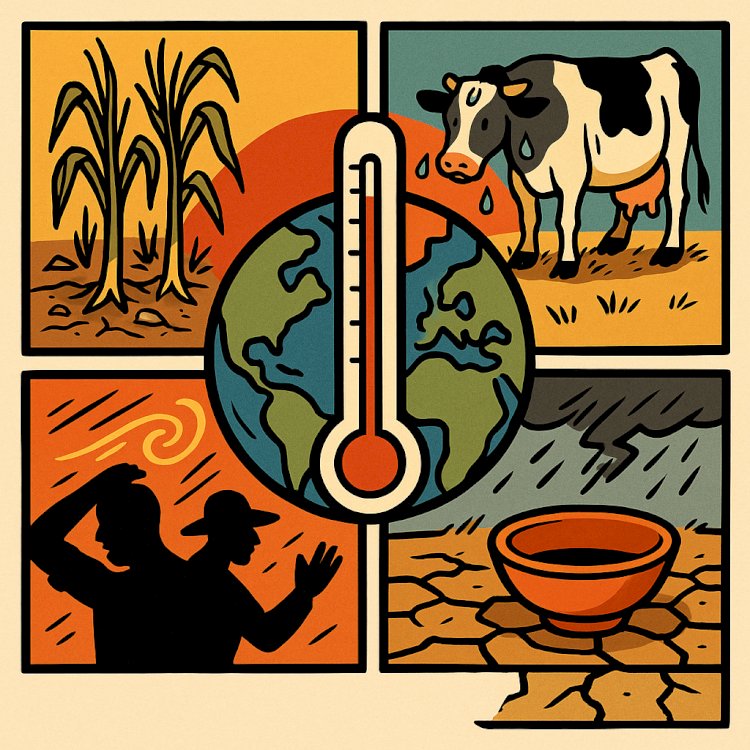
The consequences extend far beyond simple production statistics, affecting an estimated 733 million food-insecure people globally, while climate change alone was responsible for driving an additional 151 million people into moderate or severe food insecurity in 2022[3]. As agricultural productivity faces projected declines of 21% to 9% by 2080 in sub-Saharan Africa[4], and with livestock systems experiencing increasing heat stress that reduces milk production and fertility[5], the urgent need for comprehensive adaptation strategies becomes paramount for ensuring global food security in an era of accelerating climate change.
Overview of Climate Change Trends
Global climate patterns are experiencing unprecedented changes that directly threaten agricultural stability and food production systems worldwide. Earth's temperature has risen by an average of 0.11°F (0.06°C) per decade since 1850, culminating in a total increase of approximately 2°F, with the rate of warming accelerating significantly since 1975 to 0.36°F (0.20°C) per decade[1]. The year 2024 marked a critical milestone as the first year with global temperature clearly exceeding 1.5°C above pre-industrial levels, with eleven months of the year surpassing this threshold established by the Paris Agreement[6]. This warming trend shows no signs of abating, as the ten warmest years in the 175-year temperature record have all occurred within the last decade (2015-2024)[1].
The acceleration of global warming has profound implications for agricultural systems that have evolved under relatively stable climatic conditions. Since the late 1970s, the global warming trend has averaged an increase of around 0.2°C per decade, with natural climate drivers contributing minimal temperature changes of -0.1°C to +0.1°C compared to the 1.0°C to 2.0°C warming attributed to greenhouse gases[1][6]. Current projections indicate that without significant emission reductions, global temperatures could increase by 5 to 10.2°F by the end of this century, while even aggressive mitigation efforts would still result in warming of 2.4 to 5.9°F above mid-20th century levels[1]. The atmospheric carbon dioxide concentrations have risen more than 50% since the beginning of fossil fuel use, with current activities adding approximately 11 billion metric tons of carbon annually to the atmosphere[1][7].
These temperature increases are accompanied by fundamental shifts in precipitation patterns, extreme weather events, and seasonal variability that directly impact agricultural productivity. Research indicates that the planet is likely to experience 2°C warming by 2050 even under low-emission scenarios, suggesting potential failure to meet Paris Agreement targets[8]. The combined effects of rising temperatures, altered rainfall patterns, and increased frequency of extreme weather events create a complex web of challenges for global food systems. Temperature changes have not been uniform across the planet, with some regions experiencing more pronounced warming than others, creating disparate impacts on agricultural zones and food production capabilities[1][9].
Impact on Crop Yields and Livestock
Climate change is fundamentally altering agricultural productivity through multiple interconnected pathways that affect both crop yields and livestock performance. Global climate variability now accounts for approximately 32-39% of observed yield variability in major staple crops including maize, rice, wheat, and soybean, translating to annual production fluctuations of 22 million tons for maize, 3 million tons for rice, 9 million tons for wheat, and 2 million tons for soybean[2]. In many of the world's major breadbasket regions, including the Midwestern United States, Chinese Corn Belt, Western Europe, and Australia, climate variability explains more than 60% of yield variability, highlighting the critical vulnerability of global food production to climate fluctuations[2]. Research demonstrates that nationwide studies show a 15% potential decrease in corn yields for each degree increase in growing-season maximum temperature, with weather-related variability capable of reducing yields by as much as 80% in specific regions[10].
The impact of rising temperatures on crop nutritional quality presents an additional dimension of concern for global food security. Elevated atmospheric CO₂ concentrations, while initially beneficial for crop productivity at lower temperature increases, significantly reduce the nutritional value of staple foods[11]. Wheat grown at 546-586 ppm CO₂ contains 5.9-12.7% less protein, 3.7-6.5% less zinc, and 5.2-7.5% less iron compared to plants grown under current atmospheric conditions[11]. Climate change also affects the distribution of pests and diseases, negatively impacting production in many regions and creating additional challenges for maintaining stable crop yields[11]. By mid-century, climate change is projected to expose 30-79% of key nutrients including folate, iron, vitamin A, and B₁₂ to increasing climate risks, potentially leading to a 30% increase in childhood stunting[3].
Livestock systems face severe challenges from increasing temperatures and heat stress, with consequences that extend throughout the production cycle. Heat stress in dairy cattle begins at temperatures as low as 65°F for high-producing cows in well-ventilated barns, while general heat stress typically starts around 72°F with 50% humidity[12]. The effects of heat stress on livestock include reduced feed intake, decreased milk production, impaired reproductive performance, increased susceptibility to disease, and in extreme cases, increased mortality[13][5]. Research indicates that heat stress can reduce the fat and protein content of milk, decrease egg size and shell thickness, and alter the color and water-holding capacity of meat products[14]. The Temperature Humidity Index (THI) serves as a critical tool for assessing heat stress risk, with values above 89 indicating extreme heat stress for temperate cattle breeds and values above 94 for tropical breeds[13].
The long-term implications of heat stress extend beyond immediate production losses to affect future generations of livestock. Animals exposed to heat stress in utero show reduced milk yield at first lactation, altered nutrient partitioning, and modified carcass composition[14]. Climate change impacts on livestock feed production further compound these challenges, as more unstable weather conditions lead to increased post-harvest losses, particularly in developing countries where smallholder farmers rely on sun-drying for crop preservation[14]. The increasing frequency and intensity of extreme weather events, including storms, floods, and wildfires, pose additional threats to livestock systems, as demonstrated by the loss of approximately half a million livestock in northern Australia in 2019 and over 2 million chickens in Georgia following Hurricane Michael in 2018[14].
Regional Disparities and Vulnerabilities
Climate change impacts on food security exhibit profound regional variations, with developing nations and specific geographic regions facing disproportionately severe consequences. Sub-Saharan Africa emerges as particularly vulnerable, where the United Nations Development Report indicates that one in four households cannot access adequate food, and agricultural productivity is projected to decline by 21% to 9% by 2080 due to climate change[4]. In South Africa specifically, while the country is nationally food secure, between 58% and 73% of households experience food insecurity, with climate change affecting food availability, accessibility, utilization, and affordability[4]. The vulnerability of African food systems is further highlighted by research showing that since 1961, anthropogenic climate change has been attributed to a 34% loss in agricultural total factor productivity across the continent[15].
The Horn of Africa demonstrates the acute sensitivity of regional food systems to climate variability, with studies revealing that a 1% increase in mean temperature leads to a 0.357% rise in food insecurity, while a 1% increase in precipitation results in only a 0.023% decrease in food insecurity[15]. This asymmetric relationship underscores how temperature increases have far more pronounced negative effects than precipitation increases have positive effects on food security. Climate change is particularly affecting food security in drylands, especially those in Africa, and high mountain regions of Asia and South America, where agricultural systems are already stressed by challenging environmental conditions[11]. The Sahel region exemplifies these vulnerabilities, where climate change accelerates land degradation through wind and water erosion and droughts, while agricultural yields, food quality, and availability are all negatively affected[16].
Regional economic disparities further exacerbate climate-related food insecurity, with low-income consumers bearing disproportionate risks. Economic models project increases of 1-183 million additional people at risk of hunger across different Shared Socio-economic Pathways compared to scenarios without climate change[11]. In Tanzania, projected temperature increases of 2°C by 2050 are expected to reduce average production of maize, sorghum, and rice by 13%, 8.8%, and 7.6% respectively[4]. Similarly, in Ethiopia, food production faces severe challenges due to climate change, with annual production losses to climate variability increasing significantly from year to year[4]. These regional impacts are particularly concerning given that the agricultural industry is responsible for more than 60% of full-time employment in Africa, making millions of people dependent on climate-sensitive sectors for their economic well-being[15].
The vulnerability patterns across regions reflect broader structural inequalities in adaptive capacity and resilience. Fragile and conflict-affected countries, which include most countries in the Sahel, face additional challenges as food security is further jeopardized by infrastructure destruction and significant climate-induced displacement of large communities[16]. Sea-level rise and water salinization in coastal zones create additional risks for food systems in vulnerable regions[16]. The European Commission reports that climate change in Africa will reduce crop yields and increase food prices, forcing people to change production and consumption patterns[4]. These regional disparities highlight the need for targeted interventions that account for specific vulnerabilities and adaptive capacities of different geographic areas and socioeconomic contexts.
Socioeconomic Consequences of Food Insecurity
The socioeconomic ramifications of climate-induced food insecurity extend far beyond agricultural losses, creating cascading effects that destabilize communities, economies, and human development trajectories. The global burden of malnutrition reveals staggering statistics: 733 million people are currently food insecure, with this number rising sharply due to the COVID-19 pandemic, conflicts, and climate-related events[3]. Over 35% of the world's population cannot afford a healthy diet, representing one of the leading factors in disease and premature mortality[3]. The consequences manifest in widespread malnutrition indicators, including 148 million stunted children, 45 million wasted children, and 50% of adults who are overweight or obese[3]. These statistics underscore how climate change compounds existing nutritional challenges and creates new vulnerabilities across different demographic groups.
Economic modeling reveals that climate change will significantly impact global food markets and consumer welfare through price volatility and accessibility issues. Across various Shared Socio-economic Pathways, global crop and economic models project a 1-29% increase in cereal prices by 2050 due to climate change under RCP 6.0 scenarios, which will impact consumers globally through higher food prices with varying regional effects[11]. Low-income consumers face particularly acute risks, with economic models projecting increases of 1-183 million additional people at risk of hunger across different socioeconomic pathways compared to scenarios without climate change[11]. In 2022 alone, climate change was estimated to drive an additional 151 million people into moderate or severe food insecurity compared to the historical average from 1981-2010[3]. This demonstrates how climate impacts create immediate and measurable increases in food insecurity that disproportionately affect vulnerable populations.
The intersection of climate change and malnutrition creates complex feedback loops that perpetuate cycles of vulnerability and underdevelopment. Both climate change and malnutrition share common drivers and consequences, making it essential to align solutions rather than addressing these crises in isolation[3]. Food systems themselves are responsible for one-third of global greenhouse gas emissions that cause climate change, while climate-related increases in extreme weather events intensify risks for all forms of malnutrition through different pathways[3]. The nutritional consequences extend beyond caloric sufficiency to include micronutrient deficiencies, as climate change affects the availability and quality of diverse foods necessary for healthy diets. Research indicates that limiting warming to 1.5°C would reduce the number of people frequently exposed to extreme heatwaves by about 420 million and could reduce the probability of drought and risks related to water availability[8].
Social disruption and migration patterns emerge as critical secondary effects of climate-induced food insecurity, creating additional challenges for regional stability and development. In countries with high unemployment and poverty rates, such as South Africa where these conditions limit household access to food purchasing, climate impacts on food production create compounding vulnerabilities[4]. The agricultural sector's central role in employment, particularly in developing countries where it provides over 60% of full-time employment in Africa, means that climate-related agricultural disruptions have widespread economic consequences beyond food production[15]. Climate-induced food insecurity contributes to social tensions, migration pressures, and conflict risks, as communities struggle to maintain livelihoods in the face of declining agricultural productivity and increasing food prices. These interconnected socioeconomic consequences highlight the need for comprehensive approaches that address both immediate food security needs and underlying vulnerabilities that climate change exacerbates.
Mitigation and Adaptation Strategies
Developing effective strategies to address climate-induced food insecurity requires comprehensive approaches that integrate mitigation efforts with adaptive capacity building across multiple scales and sectors. Climate-resilient agriculture emerges as a fundamental strategy, incorporating several key principles including diversification of crops and livestock, improvement of soil health and fertility, implementation of efficient water management techniques, adoption of innovative pest and disease control methods, and enhancement of ecosystem services and biodiversity[17]. Diversification strategies reduce vulnerability to climate change impacts by spreading risks across multiple crops and livestock species, as monocultures prove more susceptible to extreme weather events, pests, and diseases[17]. Research demonstrates that diverse agricultural systems are better equipped to withstand variations in climate conditions and provide more stable food production under changing environmental circumstances.
Soil health management and water conservation represent critical foundations for climate adaptation in agricultural systems. Improving soil organic matter content, using cover crops, and practicing conservation tillage enhance soil health and minimize erosion, creating more resilient agricultural systems that can withstand extreme weather events while maintaining productivity[17]. Efficient water management techniques, including drip irrigation, rainwater harvesting, and water conservation measures, are essential for adapting to changing precipitation patterns and ensuring water availability during drought periods[17]. Agroforestry systems provide multiple benefits by integrating trees with agricultural crops or livestock systems, contributing to climate change mitigation through carbon dioxide absorption while offering shade, windbreaks, and fodder for animals[17]. These practices create synergistic effects that simultaneously address climate mitigation and adaptation needs.
Technological innovations and climate-informed decision-making processes enhance farmers' capacity to adapt to changing climate conditions effectively. Access to climate data and forecasts aids farmers in making informed decisions regarding crop selection, planting and harvesting timing, and risk management practices[17]. Climate-smart agricultural practices, including conservation tillage, crop rotation, and integrated pest management, aim to maximize productivity while minimizing negative environmental impacts[17]. The development and deployment of climate-resilient crop varieties that can withstand higher temperatures, drought conditions, and extreme weather events represent crucial technological adaptations for maintaining food production under changing climate conditions. Selection of heat-adapted livestock breeds, while potentially affecting product quality, provides another avenue for maintaining animal productivity under increasing temperature stress[14].
Agroecology emerges as a comprehensive approach that addresses both climate resilience and broader sustainability goals within food systems. Agroecological farming techniques help make soils more productive, minimize the use of agrochemicals and pollution, and enhance crop diversity, making agriculture more resilient to climate impacts[18]. This approach focuses on ecosystem-based methods that can enhance agricultural production systems while improving human well-being and environmental sustainability[18]. The Scaling Up Agroecology Initiative, launched by FAO with support from UNEP and other United Nations partners, works with food producers, governments, and stakeholders to promote agroecological practices globally[18]. Integration of climate resilience into existing farming systems requires guidance on selecting climate-resilient crop varieties, improving water management, implementing soil conservation practices, diversifying farm enterprises, and incorporating agroforestry systems[17]. These comprehensive strategies recognize that successful adaptation requires coordinated efforts across multiple levels, from individual farm management to policy frameworks that support climate-resilient agricultural transitions.
Conclusion
The analysis of climate change impacts on global food security reveals a complex and urgent challenge that demands immediate, coordinated action across multiple scales and sectors. The evidence demonstrates that climate change is already fundamentally altering agricultural systems worldwide, with 2024 marking unprecedented global temperatures and the first year to exceed 1.5°C above pre-industrial levels[1][6]. Climate variability now accounts for approximately one-third of global crop yield variability, affecting millions of tons of staple food production annually, while livestock systems face increasing heat stress that compromises productivity, health, and reproductive performance[2][13][5]. The regional disparities in vulnerability highlight how developing nations, particularly in sub-Saharan Africa and the Sahel, bear disproportionate consequences despite contributing least to global greenhouse gas emissions[15][16][4].
The socioeconomic ramifications extend far beyond agricultural production losses, with climate change driving an additional 151 million people into food insecurity in 2022 alone and threatening to increase childhood stunting by 30% by mid-century[3]. The interconnected nature of climate change and malnutrition creates cascading effects that perpetuate cycles of vulnerability, affecting not only immediate food access but also long-term human development outcomes through reduced nutritional quality of staple foods and increased exposure to extreme weather events[11][3]. Low-income consumers face particularly acute risks, with economic models projecting potentially 183 million additional people at risk of hunger under various climate scenarios[11].
However, the comprehensive review of adaptation and mitigation strategies reveals significant opportunities for building resilience within global food systems. Climate-resilient agriculture practices, including crop and livestock diversification, soil health improvement, efficient water management, and agroforestry integration, offer pathways for maintaining productivity while adapting to changing environmental conditions[17]. Agroecological approaches demonstrate potential for simultaneously addressing climate adaptation, environmental sustainability, and food security through ecosystem-based farming methods that enhance biodiversity and reduce external inputs[18]. The integration of technological innovations, climate-informed decision-making, and policy frameworks that support sustainable agricultural transitions represents a crucial foundation for addressing these interconnected challenges.
Moving forward, the evidence strongly supports the need for integrated approaches that recognize the inseparable linkages between climate change and food security. Success in addressing these challenges requires coordinated efforts that span from local farm-level adaptations to global policy frameworks, emphasizing both immediate responses to current vulnerabilities and long-term strategies for building systemic resilience. The stakes are particularly high given projections that global temperatures may reach 2°C warming by 2050 even under optimistic emission scenarios[8], necessitating urgent action to protect the world's most vulnerable populations while building sustainable food systems capable of feeding a growing global population under increasingly challenging climatic conditions. The evidence presented underscores that addressing climate change and food security together, rather than in isolation, offers the greatest potential for creating effective, sustainable solutions that protect both human welfare and planetary health.
- https://www.climate.gov/news-features/understanding-climate/climate-change-global-temperature
- https://www.nature.com/articles/ncomms6989
- https://micronutrientforum.org/wp-content/uploads/2025/02/ST4N_The-Climate-Crisis-and-the-Nutrition-Crisis-are-Intertwined_Policy-Brief_Feb-2025.pdf
- https://pmc.ncbi.nlm.nih.gov/articles/PMC6014268/
- https://pmc.ncbi.nlm.nih.gov/articles/PMC4823286/
- https://climate.copernicus.eu/global-climate-highlights-2024
- https://www.climate.gov/climatedashboard
- https://www.downtoearth.org.in/climate-change/world-likely-to-see-2-c-warming-by-2050-even-under-low-emissions-predicts-new-study-87386
- https://www.epa.gov/climate-indicators/climate-change-indicators-us-and-global-temperature
- https://agriculture.auburn.edu/aaes/climate-variability-impacts-crop-yields/
- https://www.ipcc.ch/srccl/chapter/chapter-5/
- https://extension.umn.edu/dairy-milking-cows/heat-stress-dairy-cattle
- https://pmc.ncbi.nlm.nih.gov/articles/PMC9292043/
- https://pmc.ncbi.nlm.nih.gov/articles/PMC7938222/
- https://en.wikipedia.org/wiki/Climate_change_and_food_security_in_Africa
- https://www.brookings.edu/articles/climate-change-and-food-security-in-the-sahel/
- https://thefarminginsider.com/climate-resilient-agriculture/
- https://www.unep.org/news-and-stories/story/agroecology-contribution-food-security
What's Your Reaction?