Infinite Growth on a Finite Planet: A Sustainable Future or a Collision Course?
Our global economy is built on the premise of perpetual growth, yet it operates within the confines of a finite planet. This article delves into the critical conflict between infinite economic expansion and Earth's limited resources, exploring technological hopes, biophysical laws, and the alternative paradigms shaping a new definition of prosperity.
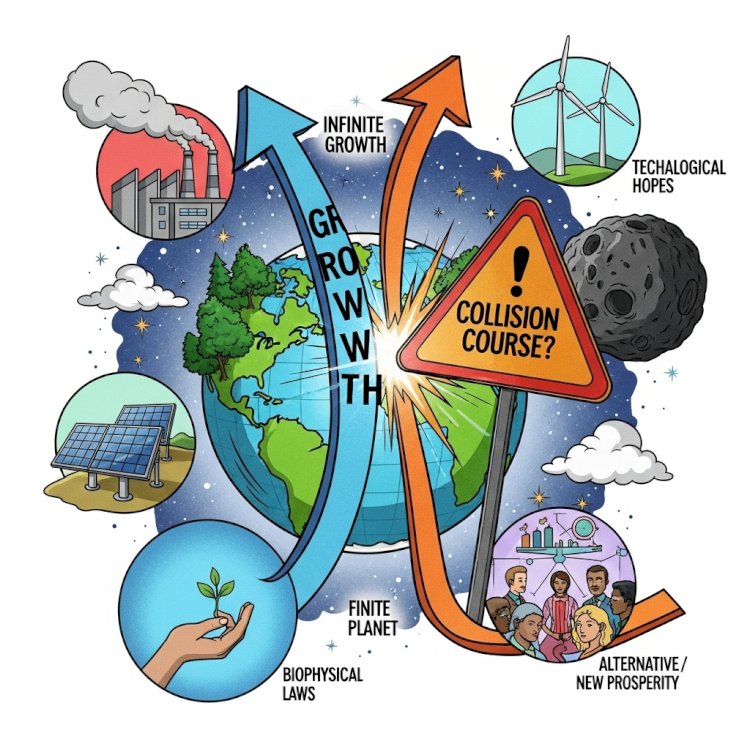
1. Introduction: The Unsettling Paradox of Modern Economics
For centuries, the engine of human progress has been fueled by a simple, powerful idea: economic growth. It is the bedrock of modern policy, the promise of politicians, and the aspiration of nations. We measure our success by the upward tick of a single metric, Gross Domestic Product, assuming that a rising tide of production will lift all boats, creating wealth, jobs, and better lives. Yet, this relentless pursuit of more has led us to a profound and unsettling paradox. How can we sustain infinite growth on a planet with decidedly finite resources?
This is no longer a fringe academic question; it is the central challenge of the 21st century. The escalating climate crisis, staggering biodiversity loss, and depletion of essential resources like fresh water and fertile soil are tangible signs that our economic model is in direct conflict with the planetary systems that sustain us. Our global economy is operating on a borrowed tab from nature, and the bill is coming due.
This article confronts this collision course head-on. We will dissect the foundational concepts of economic growth and planetary limits, examining the data that reveals the scale of our ecological overshoot. We will explore the mainstream argument for a “green growth” future, where technological innovation promises to decouple prosperity from planetary harm. Then, we will turn to the sobering biophysical critique, grounded in the laws of thermodynamics, which questions the very possibility of perpetual material growth. Finally, we will navigate the hopeful and necessary visions of alternative paradigms - from Degrowth and Doughnut Economics to Circular and Well-being Economies - that seek to redefine prosperity and build a future where both humanity and the planet can thrive.
2. Understanding the Core Concepts: Growth and Its Limits
To grasp the magnitude of the challenge, we must first define our terms. The debate over growth is clouded by assumptions and metrics that often obscure more than they reveal. By clarifying what we mean by “economic growth” and what science tells us about our planet’s “limits,” the conflict comes into sharp focus.
What is Economic Growth?
Traditionally, economic growth signifies an increase in the production of goods and services in an economy, most commonly measured by Gross Domestic Product (GDP) [1, 2]. GDP is the total monetary value of everything a country produces. This growth can be extensive, meaning it uses more resources (more labor, more capital, more raw materials), or intensive, meaning it uses existing resources more efficiently through technological or productivity gains [1].
However, relying on GDP as the primary indicator of national success has critical flaws. It famously ignores non-market activities like volunteer work and unpaid care. More importantly, it is blind to environmental costs. An oil spill cleanup increases GDP because of the money spent, but the devastating environmental damage is never subtracted [2, 11]. GDP says nothing about income inequality, resource depletion, or whether the growth it measures is sustainable in the long run [2].
Defining Our Planet's Boundaries
While economists were focused on GDP, Earth system scientists were defining the biophysical constraints of our world. This led to the creation of the Planetary Boundaries framework, a concept developed in 2009 by an international team of scientists [8]. This framework identifies nine critical Earth system processes - such as climate change, biosphere integrity, and freshwater change - that regulate the stability of our planet.
For each process, the framework defines a quantitative boundary, creating a “safe operating space” for humanity. Transgressing these boundaries dramatically increases the risk of triggering abrupt and potentially irreversible environmental changes [8, 18]. The science is clear: human activity, especially since the Industrial Revolution, is the main driver pushing us past these limits. As of 2023, the situation is alarming: we have already transgressed six of the nine planetary boundaries, including climate change, biodiversity loss, and the nitrogen and phosphorus cycles [17].
The Reality of Resource Depletion
Crossing planetary boundaries has a direct consequence: resource depletion, the consumption of natural resources faster than they can be regenerated [3, 20]. Since 1970, global resource extraction has more than tripled, driven by a fivefold increase in the use of non-metallic minerals and a 45% rise in fossil fuel consumption [14]. This relentless extraction is responsible for half of all global greenhouse gas emissions and over 90% of biodiversity loss and water stress [14].
Consider these stark examples:
- Water: Only 2.5% of the planet's water is freshwater. By 2025, an estimated 1.8 billion people are expected to face absolute water scarcity [15, 21].
- Fossil Fuels: At 2010 production rates, known reserves of oil and natural gas were estimated to last only another 46 and 59 years, respectively [16].
- Phosphorus: A non-substitutable element essential for fertilizers and agriculture, global phosphorus reserves could be depleted within 50 to 100 years [16].
If current trends continue, global material use is projected to nearly double from 92 billion tonnes today to 190 billion tonnes by 2060, further accelerating climate change and ecological collapse [14].
Measuring Our Impact: The Ecological Footprint and Carrying Capacity
Two other concepts help quantify our predicament. The Ecological Footprint measures human demand on nature against the planet's ability to regenerate, known as biocapacity [19, 22]. For over four decades, our demand has exceeded what the Earth can sustainably provide. This state is called ecological overshoot. As of 2023, humanity's ecological footprint was 1.71 Earths, meaning we use 71% more resources than the planet can regenerate in a year [12, 22]. This deficit is covered by liquidating our natural capital - depleting fish stocks, eroding soil, and accumulating carbon dioxide in the atmosphere.
This ties directly to the concept of carrying capacity: the maximum population that an environment can sustain indefinitely without degradation [4, 5, 23]. By consistently running an ecological deficit, we are far exceeding Earth's carrying capacity, undermining the very systems that support human civilization.
3. The Mainstream Case: Can Technology Decouple Growth from Destruction?
Faced with these alarming realities, the dominant economic and political response is not to question growth itself, but to change its nature. The mainstream argument, often packaged as “green growth,” hinges on the optimistic belief that human ingenuity can sever the link between economic expansion and environmental harm through technology and policy.
The Theory of Decoupling
The central concept here is decoupling, which refers to the separation of economic growth from environmental pressures like resource use and CO2 emissions [25, 26]. The goal is to allow GDP to continue its upward trajectory while the line representing environmental damage flattens or, ideally, heads downward.
A crucial distinction exists between two types of decoupling [27, 29]:
- Relative Decoupling: This occurs when environmental impacts grow, but at a slower rate than GDP. Globally, we have seen relative decoupling of CO2 emissions from economic growth over the past two decades [28]. This means we are becoming more carbon-efficient, but overall emissions are still rising.
- Absolute Decoupling: This is the ultimate goal, where resource use and environmental impact decrease in absolute terms even as the economy grows. Some wealthy nations have achieved this for specific pollutants. For example, between 1985 and 2016, the UK's CO2 emissions fell by 34% while its GDP per capita grew by over 70% [30]. However, this is often achieved by offshoring manufacturing (and its associated pollution) to other countries, and achieving sustained, global absolute decoupling remains highly contentious and unproven [28].
Green Growth and the Environmental Kuznets Curve
Green growth is the strategy built on the promise of decoupling. Promoted by institutions like the World Bank and the OECD, it argues that investments in renewable energy, resource efficiency, and circular economy models can foster innovation and create new economic opportunities while simultaneously reducing environmental impacts [29, 31, 41].
This idea is supported by a hypothesis known as the Environmental Kuznets Curve (EKC). The EKC suggests an inverted U-shaped relationship between economic development and environmental degradation [32, 33]. In theory, as a country industrializes, pollution worsens, but once it reaches a certain level of wealth, it can afford better technology and stronger regulations, leading to environmental improvements. However, the EKC is a theoretical model that doesn't hold true for all environmental indicators, and there is little evidence to support it for overall resource consumption or biodiversity loss [33, 34].
The Jevons Paradox and the Limits of Optimism
A significant challenge to the green growth narrative is the Jevons Paradox. In the 19th century, William Stanley Jevons observed that as technological improvements made steam engines more efficient, coal consumption increased, not decreased [35, 37]. This is because efficiency lowers the cost of using a resource, which can spur greater overall demand - a phenomenon known as the rebound effect [36]. Today, we see this with fuel-efficient cars; people may feel justified in driving more, offsetting some or all of the energy savings. This paradox suggests that efficiency gains alone are insufficient without policies that directly limit resource consumption.
This highlights the risk of unchecked technological optimism - the belief that technology will inevitably solve our environmental problems [39, 40]. While innovation in areas like renewable energy and carbon capture is vital, an over-reliance on it can lead to “technowashing,” where the promise of future solutions becomes an excuse for inaction on the necessary social, political, and behavioral changes needed today [39].
4. The Biophysical Critique: When Economics Meets the Laws of Physics
While mainstream economics places its faith in technology and markets, a different school of thought, ecological economics, argues that this view ignores a fundamental truth: the economy is a subsystem of the Earth's finite biosphere and is therefore governed by the laws of physics.
Thermodynamics and the Economy
The biophysical critique is rooted in the laws of thermodynamics, which describe how energy and matter behave in the universe.
- The First Law of Thermodynamics (Conservation of Energy) states that matter and energy cannot be created or destroyed [43]. For an economy, this means every piece of raw material taken from the environment must eventually be returned to it as waste [43, 44]. There is no “away” to throw things to.
- The Second Law of Thermodynamics (The Entropy Law) is even more profound. It states that in any closed system, entropy - a measure of disorder or uselessness - always increases [45]. Pioneering ecological economist Nicholas Georgescu-Roegen applied this to economics, explaining that all economic processes are entropic [44, 47]. We take low-entropy (useful, structured) resources like metal ores and fossil fuels and transform them into products, but in the process, we inevitably generate high-entropy (disordered, dissipated) waste and pollution [44, 54]. This flow is irreversible. You cannot “un-burn” a lump of coal.
This physical reality directly contradicts the conventional economic model of a circular flow of money, which treats the economy as an isolated system without physical inputs or outputs [54]. The Entropy Law dictates that a growing economy requires a constantly increasing flow of low-entropy resources from the planet and expels an ever-larger stream of high-entropy waste back into it.
The Principles of Ecological Economics
Built on this biophysical foundation, ecological economics challenges the core tenets of neoclassical economics [46]. It argues that the economy must operate within the Earth's limits, prioritizing three key goals [52]:
- Sustainable Scale: The size of the economy must not exceed the regenerative and absorptive capacity of the ecosystem.
- Fair Distribution: Resources and wealth must be distributed equitably within the current generation and between current and future generations.
- Efficient Allocation: Once scale and distribution are addressed, resources should be allocated efficiently to meet human needs.
A Warning from the Past: The "Limits to Growth" Study
One of the most influential works in this field was the 1972 report, The Limits to Growth, commissioned by the Club of Rome [48]. Using a computer model to simulate the interactions between population, industrial output, food production, resource depletion, and pollution, the MIT research team came to a stark conclusion: if business-as-usual growth trends continued, the world would reach its limits within 100 years, leading to a “sudden and uncontrollable decline in both population and industrial capacity” [48, 56].
Updates in 1992 and 2004 reinforced these warnings, concluding that humanity was already in a state of overshoot [49, 58]. Frighteningly, a 2023 study that recalibrated the model with four decades of real-world data found that we are tracking the original “business-as-usual” scenario with alarming accuracy, putting the global system on a path toward economic and population decline starting around 2030 [50, 57].
Herman Daly's Vision: The Steady-State Economy
Building on these insights, ecological economist Herman Daly championed the concept of a Steady-State Economy (SSE) [51, 60]. An SSE is an economy with constant stocks of people and physical capital (wealth), maintained at a sustainable level by the lowest feasible rate of material and energy throughput [51, 61].
Crucially, a steady-state economy is not a stagnant one. Daly made a clear distinction between growth (a quantitative increase in physical size) and development (a qualitative improvement in well-being, technology, and culture) [59]. He argued that while physical growth is limited by planetary boundaries, qualitative development can continue indefinitely. Daly also coined the term uneconomic growth, describing the point at which the social and environmental costs of further GDP growth (the “illth” it generates) begin to outweigh the benefits [59, 61]. He contended that high-income nations have long since passed this threshold.
5. Forging New Paths: Alternative Paradigms for a Thriving Future
The biophysical critique makes it clear that a fundamental rethink of our economic goals is necessary. In response, a vibrant ecosystem of alternative paradigms has emerged, each offering a different vision for a future that prioritizes human and ecological well-being over the narrow pursuit of GDP growth.
Moving Beyond Growth: Degrowth and Post-Growth Economics
The degrowth movement advocates for a planned, democratic, and equitable downscaling of production and consumption in high-income countries to bring society back within planetary boundaries [62, 63]. It is not a call for recession or austerity but a purposeful shift towards a smaller, slower, and more localized economy focused on well-being, solidarity, and ecological sustainability [63, 82]. Degrowth proponents argue for policies like a shorter work week, universal basic services, and wealth redistribution to ensure a just transition [71].
Degrowth is part of the broader umbrella of post-growth economics, which encompasses any framework that moves beyond GDP as the primary goal of society [71, 72]. The central idea is that prosperity and a high quality of life are achievable without perpetual economic expansion.
Kate Raworth's Doughnut Economics
To visualize this new goal, Oxford economist Kate Raworth developed Doughnut Economics. The model consists of two concentric rings, creating a shape like a doughnut [66, 67].
- The inner ring represents the social foundation, encompassing the essential requirements for a dignified life, such as food, water, housing, healthcare, education, and political voice. No one should fall short of this foundation.
- The outer ring represents the ecological ceiling, corresponding to the nine planetary boundaries that we must not overshoot to avoid critical environmental destabilization.
The space between these two rings - the doughnut itself - is the “safe and just space for humanity,” where human needs are met within the means of the living planet [66]. The goal of economic policy, therefore, should be to get every person into the doughnut, shifting our focus from endless growth to achieving a regenerative and distributive balance.
Closing the Loop: The Circular Economy
The Circular Economy offers a practical model to transform our industrial processes, moving away from the linear “take-make-waste” system [69]. It is an economic system based on three principles, driven by design [70]:
- Eliminate waste and pollution: By designing products intelligently from the start, we can prevent waste from ever being created.
- Keep products and materials in use: We must prioritize durability, repair, reuse, remanufacturing, and recycling to keep resources circulating at their highest value for as long as possible.
- Regenerate natural systems: Economic activity should not just be “less bad” but actively restorative, helping to rebuild natural capital through practices like regenerative agriculture.
By decoupling economic activity from the consumption of finite resources, the circular economy offers a pathway to reduce emissions, halt biodiversity loss, and create new economic opportunities [69, 70].
Redefining Progress: Well-being Economies and the SDGs
A growing number of governments are beginning to put these ideas into practice through Well-being Economy frameworks. Nations like Scotland, New Zealand, Iceland, Wales, and Finland have formed the Wellbeing Economy Governments (WEGo) partnership, committing to place human and ecological well-being at the heart of their policy-making [75, 76]. New Zealand's “Wellbeing Budget,” for example, directs government spending towards specific outcomes like improving mental health, reducing child poverty, and tackling climate change, rather than simply maximizing GDP [76].
This shift also reveals a deep tension within global development efforts like the United Nations' Sustainable Development Goals (SDGs). The 17 SDGs are an ambitious blueprint for a better world, covering everything from poverty to climate action [80]. However, SDG 8 explicitly calls for “sustained, inclusive and sustainable economic growth,” including a target of at least 7% annual GDP growth in the least developed countries [79]. Many critics argue that this goal is fundamentally incompatible with environmental goals like SDG 13 (Climate Action) [74, 81]. Evidence strongly suggests that the level of decoupling required to reconcile even moderate GDP growth with our climate targets is not happening and is likely impossible to achieve on a global scale [81].
6. Conclusion: A Choice Between Infinite Ambition and Finite Reality
We stand at a historic crossroads, forced to confront the foundational assumption of our economic age. The doctrine of infinite growth, once a powerful engine of progress, has collided with the biophysical limits of a finite planet. The evidence is all around us: a destabilizing climate, collapsing ecosystems, and dwindling resources.
The mainstream response is a wager on human ingenuity - a faith that technology can achieve the grand separation of growth from its devastating impacts. Yet this hope is challenged by the persistent reality of rebound effects and the unyielding laws of thermodynamics, which tell us that all economic activity has a physical cost.
From this tension, a new and necessary vision of prosperity is emerging. Paradigms like Doughnut Economics, the Circular Economy, and Well-being frameworks are not about returning to a primitive past; they are about designing a sophisticated future. They call on us to shift our goal from the empty pursuit of “more” to the richer, more meaningful pursuit of “better” - better health, stronger communities, and a regenerated natural world.
The ultimate question is not if growth will end, but how. Will it end through uncontrolled collapse, as the Limits to Growth models have long warned? Or will it end by design, through a planned and just transition to a steady-state economy that operates in balance with the living world? The choice is ours, and it will define the fate of human civilization for centuries to come.
References
- Economic Growth (investopedia.com)
- Gross domestic product (wikipedia.org)
- Resource Depletion (ebsco.com)
- Carrying capacity (pressbooks.pub)
- Carrying Capacity: Definition, Importance & Examples (fiveable.me)
- Carrying Capacity (lumenlearning.com)
- Ecological footprint (khanacademy.org)
- The nine planetary boundaries (stockholmresilience.org)
- Natural resource depletion (sustainability-directory.com)
- The Planetary Boundaries framework (ethz.ch)
- Limitations of GDP as a measure of economic welfare (wikipedia.org)
- Global Ecological Footprint (concito.dk)
- Ecological footprint (wikipedia.org)
- Global material flows and resource productivity (unep.org)
- Water (un.org)
- Depletion of Natural Resources (theworldcounts.com)
- Humanity has breached six of nine planetary boundaries (theguardian.com)
- Planetary boundaries (wikipedia.org)
- What is an Ecological Footprint? (selectra.com)
- Resource Depletion: Causes, Effects and Solutions (ecoonline.com)
- How Much Water Is There on Earth? (treehugger.com)
- Ecological Footprint (panda.org)
- Carrying Capacity: AP® Environmental Science Crash Course (fiveable.me)
- Carrying capacity (sustainability-directory.com)
- A study on economic growth and CO2 emission (raghunathpurcollege.ac.in)
- Decoupling (sustaineda.org)
- Decoupling: a key, yet tricky, concept in sustainability (climateforesight.eu)
- Decoupling (sustainability) (wikipedia.org)
- Green growth (sustainability-directory.com)
- The decoupling of economic growth from carbon emissions: UK evidence (ons.gov.uk)
- Green growth (wikipedia.org)
- Environmental Kuznets curve (sustainability-directory.com)
- Kuznets Curve (tutor2u.net)
- Environmental Kuznets Curve (wikipedia.org)
- Jevons paradox (wikipedia.org)
- Jevons Paradox (economicshelp.org)
- Jevons' Paradox (exploring-economics.org)
- Technological optimism (lpcentre.com)
- Technological optimism (wikipedia.org)
- Technology cannot save us from climate change (earth.org)
- UNDP Green Growth Strategy (undp.org)
- Absolute and relative decoupling of economic growth from resource use (mdpi.com)
- Laws of thermodynamics (wikipedia.org)
- Ecological Economics (lowimpact.org)
- Thermodynamics (cfmesh.com)
- What is Ecological Economics? (nature-economy.com)
- Nicholas Georgescu-Roegen (wikipedia.org)
- The Limits to Growth (wikipedia.org)
- The Limits to Growth (donellameadows.org)
- The Limits to Growth at 50: From Scenarios to Unfolding Reality (resilience.org)
- Steady-state economy (wikipedia.org)
- Ecological Economics (ecologicaleconomicsforall.org)
- Herman Daly (wikipedia.org)
- Entropy and the economic process (tandfonline.com)
- Herman Daly (investopedia.com)
- Limits to Growth (clubofrome.org)
- Revisiting the “Limits to Growth” After 50 Years (triplepundit.com)
- Is It Too Late to Stop the ‘Limits to Growth’ Scenarios? (smithsonianmag.com)
- From Uneconomic Growth to a Steady-State Economy (steadystate.org)
- A steady-state economy (quakers.nz)
- What is a Steady State Economy? (steadystate.org)
- Degrowth (wikipedia.org)
- What is degrowth? (degrowth.net)
- Degrowth vs Post-Growth vs a-Growth (populationmatters.org)
- What is degrowth? (careaboutclimate.org)
- What is Doughnut Economics? (doughnuteconomics.org)
- Doughnut (economic model) (wikipedia.org)
What's Your Reaction?