The Secret Language of the Forest: Unveiling Inter-Tree Communication and its Ecological Significance
For centuries, we have perceived forests as collections of individual trees competing for resources in a Darwinian struggle for survival. This paradigm has fundamentally shifted as groundbreaking research reveals that forests operate as interconnected communities where trees actively communicate, cooperate, and share resources through sophisticated biological networks.
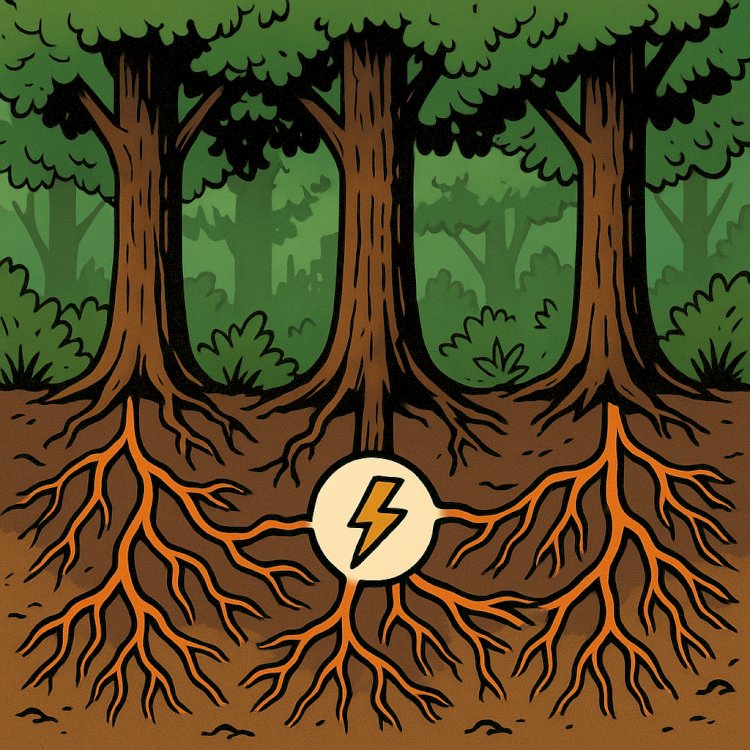
Recent scientific discoveries have unveiled a hidden world beneath our feet, where trees engage in complex conversations that influence everything from forest resilience to climate adaptation. This emerging understanding of inter-tree communication represents one of the most significant paradigm shifts in forest ecology, challenging our basic assumptions about how natural ecosystems function and revealing the profound ecological significance of what scientists now call the "wood-wide web."
Understanding Inter-Tree Communication: Beyond Competition
The traditional view of forests as battlegrounds where individual trees compete for limited resources has been fundamentally challenged by mounting scientific evidence. Forest trees have evolved to live in cooperative, interdependent relationships, maintained by communication and a collective intelligence similar to an insect colony[1]. This revolutionary understanding emerged from decades of research that revealed trees of the same species form communal relationships and often create alliances with trees of different species, fundamentally altering our perception of forest dynamics.
The concept of inter-tree communication encompasses multiple forms of information exchange that occur both above and below ground. Trees can communicate with each other through networks in soil, functioning much like social networks or neural networks through fungal mycelia of mycorrhizas that allow signals to be sent between trees in a forest[2]. These mycorrhizal networks effectively serve as information highways, facilitating the exchange of nutritional resources, defense signals, and allelochemicals that enable complex behavioral responses in plant communities.
Research has demonstrated that plants possess systemic signaling systems whereby local stimuli can lead to rapid, plant-wide responses[3]. This communication capability extends beyond individual plants to encompass entire forest communities, where trees can detect and respond to environmental changes, threats, and opportunities through their interconnected networks. The ability to engage in this "tree talk" represents a foundational process in forest ecosystems that influences everything from seedling survival to forest-wide responses to climate stress.
Mechanisms of Communication: The Underground Internet
Mycorrhizal Networks: The Physical Infrastructure
The primary mechanism enabling inter-tree communication lies in the mycorrhizal networks that connect forest trees through underground fungal partnerships. These networks consist of fine, hairlike root tips that join together with microscopic fungal filaments to form the basic links of what appears to operate as a symbiotic relationship between trees and fungi[1]. German forester Peter Wohlleben coined the term "wood-wide web" to describe this vast underground network that connects trees across forest landscapes[4].
The fungal mycelium, consisting of incredibly tiny threads of the greater fungal organism, wraps around or bores into tree roots, creating an extensive underground network[4]. In healthy forests, each tree connects to others via this network, enabling the sharing of water and nutrients across vast distances. As a form of payment for their services, the fungi consume approximately 30 percent of the sugar that trees photosynthesize from sunlight, while they scavenge the soil for nitrogen, phosphorus, and other mineral nutrients that are then absorbed and consumed by the trees[1].
Research conducted on Douglas-fir trees indicates that trees can recognize the root tips of their relatives and favor them when sending carbon and nutrients through the fungal network[4]. This sophisticated recognition system allows for preferential resource allocation, suggesting that forests operate not just as communities but as extended family networks with complex social structures.
Chemical Signaling and Volatile Organic Compounds
Beyond the physical infrastructure of mycorrhizal networks, trees employ sophisticated chemical communication systems that operate both through underground networks and aerial pathways. When trees face threats such as insect attacks or pathogen infections, they emit chemical signals called volatile organic compounds (VOCs) into the air[5]. These compounds function as distress signals, effectively warning nearby trees to prepare their defenses against impending dangers.
The chemical communication system enables trees to send distress signals about drought, disease, and insect attacks, prompting other trees to alter their behavior when they receive these messages[1]. This rapid communication allows forests to mount coordinated responses to threats, with receiving trees adjusting their chemical and biological defenses even before they encounter the actual threat. The sophistication of this system extends to trees' ability to differentiate between different types of threats and mount appropriate responses.
Trees also use chemical signaling to share information about resource availability and environmental conditions. During periods of abundance, trees that are receiving ample sunlight through photosynthesis share surplus carbon with neighboring trees that might be struggling in shaded conditions[5]. This resource-sharing mechanism ensures the survival of younger trees and maintains forest diversity by supporting trees that might otherwise perish due to insufficient light exposure.
Rapid Electrical and Ionic Signaling
Recent advances in plant biology have revealed the existence of rapid electrical and ionic signaling systems that complement the slower chemical communication pathways. Plants possess signaling systems driven by local stimulus perception combined with communication networks that broadcast information throughout the plant body, enabling responses to highly localized stimuli to play out in distant tissues[3]. These electrical signals can travel at rates exceeding 1,000 micrometers per second, far faster than chemical signals that typically move at rates of only micrometers per second.
The rapid signaling system involves changes in ion fluxes, reactive oxygen species (ROS), and electrical signaling that provides a parallel informational network to chemical communication[3]. This system enables forests to respond quickly to environmental changes and coordinate rapid responses across large areas. The discovery of specific channels, pumps, and enzymes involved in driving signal propagation has provided researchers with key anchor points for understanding how systemic signaling is triggered and propagated throughout forest communities.
Ecological Impact and Significance
Forest Resilience and Adaptive Capacity
The communication networks that connect forest trees play crucial roles in enhancing ecosystem resilience and adaptive capacity. Forests function as complex adaptive systems where the interconnected nature of tree communication creates feedback mechanisms that enhance the entire ecosystem's ability to respond to environmental changes[6]. These networks provide forest communities with the capacity to share information about environmental conditions, coordinate responses to threats, and redistribute resources to maintain ecosystem stability.
The role of mother trees, or hub trees, exemplifies the importance of communication networks in forest resilience. These older, established trees connect to hundreds of other forest trees to assist their survival, functioning as central nodes in the communication network[6]. Mother trees can recognize the needs of younger trees in shady understory conditions and send needed carbon for survival, while injured or dying trees can transfer their nutrients to nearby growing saplings to encourage new life and growth.
Research has revealed non-random interaction patterns between host trees and various ecological groups, including bryophytes, lichens, and fungi, with nested and modular structures associated with high host specificity[7]. These interaction networks show different properties depending on the type of relationship involved, with autotrophic epiphyte networks showing similarities to mutualistic networks while heterotrophic wood decomposers display characteristics similar to antagonistic networks.
Biodiversity and Species Interactions
The communication networks in forests significantly influence biodiversity patterns and species interactions across multiple scales. The mycorrhizal networks that facilitate tree communication also support complex webs of interactions between forest-dwelling organisms and their host trees[7]. These networks create opportunities for different species to interact and share resources, contributing to the maintenance of forest biodiversity.
The preferential treatment that trees show toward their own offspring and relatives through the communication networks helps maintain genetic diversity while ensuring species continuity[6]. However, diverse tree species also help each other through the networks, creating opportunities for interspecific cooperation that enhances overall forest diversity. This balance between preferential resource allocation and broader community support contributes to the complex mosaic of species interactions that characterize healthy forest ecosystems.
Studies have shown that interaction intimacy, determined by host tree specialization and driven by host tree traits, influences the prevalence of interactions across different modules within forest networks[7]. This specialization creates opportunities for niche differentiation and coexistence among species, contributing to the overall diversity and stability of forest communities.
Conservation and Climate Change Implications
Rethinking Forest Management Strategies
Understanding inter-tree communication has profound implications for forest management and conservation strategies. The recognition that forests operate as interconnected communities rather than collections of individual trees competing for resources necessitates a fundamental shift in how we approach forest management[8]. Traditional timber industry practices that view forests as wood-producing systems and battlegrounds for survival of the fittest fail to account for the complex cooperative relationships that maintain forest health.
Conservation strategies must now consider the integrity of mycorrhizal networks and communication pathways when planning forest interventions. Practices that disrupt these underground networks, such as clear-cutting or soil compaction, can have far-reaching consequences for forest resilience and recovery[6]. Forest management approaches that preserve mother trees and maintain network connectivity are essential for supporting natural regeneration and ecosystem recovery.
The understanding of tree communication also informs restoration ecology practices, where the establishment of appropriate mycorrhizal partnerships and communication networks becomes crucial for successful ecosystem restoration. Restoration projects that fail to consider these underground connections may struggle to establish self-sustaining forest communities capable of long-term survival and growth.
Climate Adaptation and Ecosystem Services
Forest communication networks play increasingly important roles in climate adaptation and the provision of ecosystem services. As climate change intensifies environmental stresses, the ability of forests to communicate and coordinate responses becomes critical for ecosystem survival[8]. Trees' capacity to share information about changing environmental conditions and redistribute resources to support stressed individuals enhances the overall resilience of forest ecosystems to climate impacts.
The communication networks enable forests to respond more effectively to climate-related stresses such as drought, temperature extremes, and shifting precipitation patterns. Trees can share water resources through mycorrhizal networks during drought periods, while also communicating information about optimal timing for leaf emergence, reproduction, and other critical life cycle events in response to changing seasonal patterns.
Understanding these communication systems also has implications for carbon sequestration and climate mitigation efforts. The cooperative relationships among trees, facilitated by communication networks, influence forest productivity and carbon storage capacity. Forests with intact communication networks may be more effective at sequestering carbon and maintaining long-term carbon storage compared to fragmented or degraded forest systems.
Conclusion
The discovery of inter-tree communication represents a paradigm shift that fundamentally alters our understanding of forest ecosystems and their ecological significance. Far from being mere collections of competing individuals, forests emerge as sophisticated communities where trees engage in complex conversations that influence everything from individual survival to ecosystem-wide responses to environmental change. The mycorrhizal networks, chemical signaling pathways, and electrical communication systems that connect forest trees create a biological internet that enables cooperation, resource sharing, and coordinated responses to environmental challenges.
This understanding has profound implications for conservation biology, climate change adaptation, and sustainable forest management. As we face unprecedented environmental challenges, recognizing and protecting the communication networks that enable forest resilience becomes increasingly critical. The secret language of the forest reveals not just how trees talk to each other, but how entire ecosystems maintain their health, diversity, and adaptive capacity through sophisticated communication systems that have evolved over millions of years. Embracing this knowledge offers new pathways for conservation strategies that work with, rather than against, the natural communication systems that sustain forest ecosystems across the globe.
- https://www.smithsonianmag.com/science-nature/the-whispering-trees-180968084/
- https://pmc.ncbi.nlm.nih.gov/articles/PMC4497361/
- https://pmc.ncbi.nlm.nih.gov/articles/PMC8133610/
- https://www.nationalforests.org/blog/underground-mycorrhizal-network
- https://dots.eco/do-trees-really-communicate-with-each-other/
- https://www.ecologyottawa.ca/2016-09-01-trees-cooperate-and-communicate-on-the-forest-internet
- https://www.stockholmresilience.org/publications/publications/2018-06-29-interaction-type-and-intimacy-structure-networks-between-forest-dwelling-organisms-and-their-host-trees.html
- https://theoec.org/news-and-information/how-trees-communicate-is-no-longer-an-alien-concept/
What's Your Reaction?