How did the Silk Road facilitate not only trade but also cultural and technological exchange across continents?
Explore how the Silk Road was more than a trade route. This in-depth article analyzes its role as a powerful engine for cultural, religious, and technological exchange across Eurasia, shaping civilizations from China to Rome.
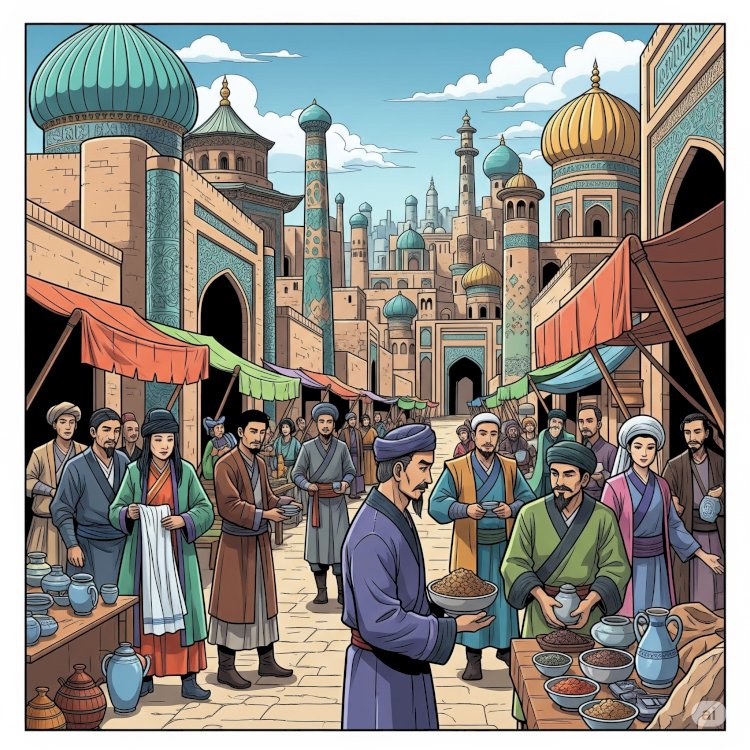
An ancient network of pathways that once pulsed with the rhythm of camel caravans and merchant ships, the Silk Road was far more than a mere conduit for commerce. It was the world’s first great artery of globalization, a sprawling system of land and sea routes that connected the vibrant civilizations of China, India, Persia, and the Mediterranean for over a millennium and a half. While its name, coined in the 19th century, evokes the lustrous fabric that captivated Roman elites, the true legacy of the Silk Road is woven from a much richer tapestry of ideas, faiths, technologies, and cultures. This intricate web of exchange did not just move luxury goods across vast and treacherous landscapes; it fundamentally reshaped societies, sparked intellectual golden ages, and laid the very groundwork for the interconnected world we know today.
The objective of this article is to explore the multifaceted role of the Silk Road, moving beyond its economic function to analyze its profound impact as an engine of cultural, religious, and technological cross-pollination. By examining the geographic scope of its networks, the nature of its commercial heart, the diffusion of profound belief systems, the transfer of world-altering innovations, and its ultimate civilizational legacy, we can begin to appreciate how this ancient network was instrumental in scripting the shared history of Eurasia.
In this article, we will explore this topic through the following key areas:
Table of Contents
-
Structure and Geography of the Silk Road
-
Trade Goods and Economic Exchange
-
Cultural Diffusion Along the Silk Road
-
Technological and Scientific Exchange
-
Long-Term Impacts on Civilizations
1. Structure and Geography of the Silk Road
The Silk Road was not a single, monolithic highway but a dynamic and ever-shifting network of interconnected routes, oases, and urban centers that spanned the breadth of the Eurasian landmass and its surrounding seas. Its geography was its destiny, a challenging yet ultimately surmountable landscape of formidable mountains, vast deserts, and expansive seas that dictated the flow of people and their products. Understanding this physical framework is essential to appreciating how such a revolutionary system of exchange could emerge and endure. The principal arteries of this network can be broadly categorized into overland and maritime routes, each presenting unique challenges and connecting distinct, yet ultimately intertwined, spheres of influence.
The overland routes are the most iconic, famously beginning in the Han Dynasty's capital, Chang'an (modern-day Xi'an) in China. From this eastern terminus, the main route pushed westward, skirting the northern and southern edges of the formidable Taklamakan Desert in Northwest China. The northern route traveled through the Gansu Corridor, passing through oasis cities like Dunhuang, a vital hub for commerce and religious pilgrimage. From there, it split, with paths going north of the Tian Shan mountains through Turpan and others going south to rejoin at the bustling city of Kashgar. The southern route, similarly challenging, navigated between the Kunlun Mountains and the desert's edge.
West of Kashgar, a critical node where these desert paths converged, the routes fanned out. One major branch headed towards the Fergana Valley, passing through Kokand and into the prosperous region of Transoxiana, home to the legendary cities of Samarkand and Bukhara in modern-day Uzbekistan. These cities became spectacular melting pots of cultures and commerce. Another branch went south from Kashgar, over the towering Pamir or Karakoram mountain ranges, through regions like Bactria (in present-day Afghanistan) with its capital Balkh, before also turning west towards Persia. The journey from China to the heart of Central Asia was an arduous one, facilitated by a "relay trade" system where goods would change hands multiple times, with few merchants ever traversing the entire 4,000-mile length of the route. From the great cities of Persia, such as Merv and later Isfahan, the routes continued toward the Levant and the Mediterranean coast, terminating in cities like Antioch, Tyre, or Alexandria, from where goods could be shipped into the vast Roman, and later Byzantine, Empire.
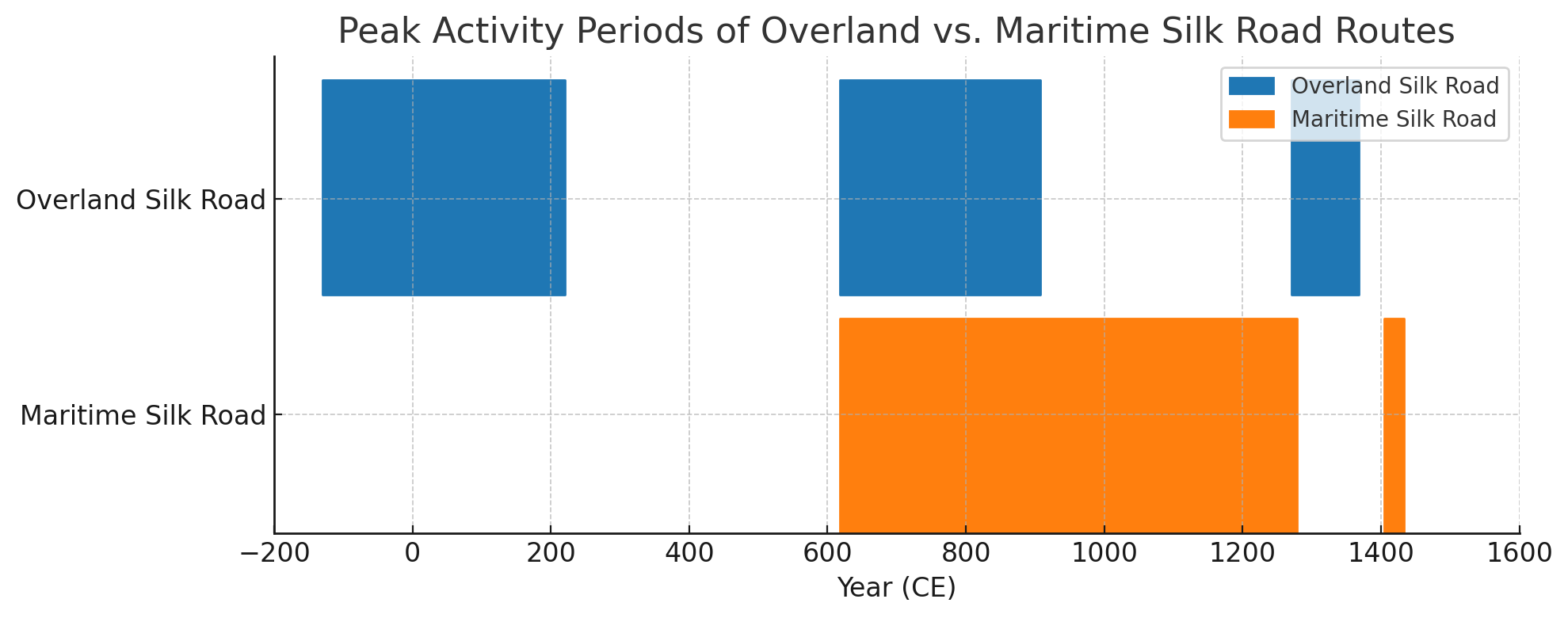
Parallel to the overland routes, a sophisticated network of maritime pathways evolved, often called the Maritime Silk Road. These sea lanes were not a secondary option but a vital and, in many periods, dominant component of intercontinental trade. Originating from southern Chinese ports like Guangzhou and Quanzhou, ships navigated the South China Sea, passing through the Straits of Malacca, a critical chokepoint. From there, they entered the Indian Ocean, a basin of vibrant maritime activity long before the rise of the overland Silk Road. Indian and Sri Lankan ports served as crucial intermediaries, connecting Chinese goods with those from the Arabian Peninsula and East Africa. Arab and Persian dhows, mastering the monsoon winds, would then carry cargoes across the Arabian Sea to ports in the Persian Gulf or the Red Sea. From Red Sea ports like Berenice, goods were transported overland to the Nile River and then to Alexandria, the gateway to the Mediterranean world. This maritime network connected Southeast Asia, India, Arabia, and Egypt, creating a rich and diverse zone of exchange that complemented the terrestrial routes. The choice between land and sea was often dictated by geopolitics; when conflicts in Central Asia or Persia rendered overland travel unsafe, the maritime routes swelled with traffic, demonstrating the network's inherent resilience and adaptability.
2. Trade Goods and Economic Exchange
At its core, the Silk Road was an economic phenomenon, a testament to the power of supply and demand across vast distances. The commerce it facilitated was not merely transactional; it was transformational, fostering the growth of urban centers, shaping the economies of empires, and creating a new class of wealthy merchants who served as the lifeblood of this network. The very existence of the Silk Road was predicated on the simple fact that one region possessed a commodity deeply coveted by another, and the most famous of these was, of course, silk.
For centuries, the Chinese held a monopoly on the complex process of sericulture - the cultivation of silkworms and the weaving of their cocoons into lustrous thread. To the Roman Empire, this fabric was a symbol of unparalleled luxury and status, its lightweight, vibrant, and sensuous qualities making it more valuable than gold. Roman elites, both male and female, clamored for silk, draining the imperial coffers to acquire it from Parthian and later Persian middlemen who controlled its westward flow. Roman writers like Pliny the Elder famously lamented the immense sums of silver and gold flowing eastward to pay for this "precious material," a clear indicator of a significant trade imbalance.
However, silk was only the marquee attraction in a vast marketplace of goods. From the East, caravans and ships carried not just silk but also spices from the Indonesian "Spice Islands" (cloves, nutmeg, mace) and India (pepper, cinnamon), which were essential for flavoring, medicine, and religious rituals in the West. China also exported porcelain, lacquerware, and iron, while Central Asian cities offered fine horses, jade, and textiles. Heading eastward, the flow of goods was equally diverse. The Roman Empire exported glassware, which was highly prized in Asia for its clarity and craftsmanship, as well as high-quality textiles, gold-embroidered carpets, and precious metals like gold and silver. India contributed cotton textiles, exotic animals, and precious stones. Persia served as both a producer and an intermediary, trading its own finely crafted silver goods, carpets, and dyes while profiting from the passage of goods in both directions.
This exchange was not conducted by a single, unified commercial entity but by a complex chain of merchants, agents, and local rulers. Sogdian traders, from the region around Samarkand, became particularly renowned as the master middlemen of the Silk Road, establishing communities in oasis towns all the way to China. The economic structure of the trade was a relay system. A Chinese merchant might transport a bolt of silk to Dunhuang, where it would be sold to a Sogdian trader, who would then carry it to Samarkand. There, it might be purchased by a Persian merchant for transport to the borders of the Byzantine Empire, where a Syrian or Greek trader would finally carry it to Constantinople or Antioch. At each stage, the price increased, reflecting the immense risks of travel, which included banditry, harsh weather, and the burden of taxes and tolls imposed by the numerous political entities along the route. Political stability was a crucial lubricant for this economic engine. The rise of large, powerful empires like the Han Dynasty in China, the Parthian and Sassanian Empires in Persia, and the Kushan Empire in Central Asia - and later, the remarkable stability imposed by the Mongol Empire - created periods of relative security that allowed trade to flourish. During times of political fragmentation, the costs and dangers of trade skyrocketed, sometimes stifling the flow of goods to a mere trickle. The wealth generated by this trade fueled the growth of magnificent cities - Samarkand, Bukhara, Merv, and Palmyra - which became vibrant cosmopolitan centers whose prosperity was directly tied to the caravans resting within their walls.
3. Cultural Diffusion Along the Silk Road
While the exchange of material goods provided the economic impetus for the Silk Road, its most enduring legacy lies in the realm of the intangible. The routes that carried silk, spices, and glass also served as powerful conduits for the transmission of ideas, religions, philosophies, and artistic traditions. As merchants, missionaries, monks, and soldiers journeyed across Eurasia, they carried their beliefs and cultural practices with them, initiating a profound and lasting dialogue between civilizations. This cross-pollination of culture created a unique spiritual and artistic syncretism, particularly in the vibrant oasis cities of Central Asia.
Perhaps the most significant cultural current to flow along the Silk Road was Buddhism. Originating in India in the 6th century BCE, Buddhism traveled northward and eastward, carried by merchants and monks who found a receptive audience in the diverse communities along the trade routes. The Kushan Empire, which straddled Central Asia and northern India, became a major patron of the faith, and from there, it spread into the Tarim Basin and eventually into China. The journey was not merely one of geographic expansion but of profound transformation. As Buddhism encountered Hellenistic (Greek) culture, a legacy of Alexander the Great's conquests, a unique artistic style known as Greco-Buddhist art emerged in the region of Gandhara (modern-day Pakistan and Afghanistan). In these works, the Buddha was depicted for the first time in anthropomorphic form, with wavy hair, toga-like robes, and facial features reminiscent of Greek sculptures of Apollo. This artistic fusion created some of the most compelling religious art in history and provided a visual language that would influence Buddhist iconography across all of East Asia. The colossal Buddhas of Bamiyan in Afghanistan, tragically destroyed in 2001, were a testament to this powerful synthesis. Dunhuang's Mogao Caves, a treasure trove of Buddhist murals and manuscripts, stand as a vivid record of the faith's deep roots along the trade routes.
Christianity also made its way eastward along these same paths. It was primarily the Church of the East, often referred to as Nestorian Christianity, that found purchase in the oasis cities of the Silk Road. Persian and Sogdian merchants played a key role in its dissemination, establishing bishoprics in major centers like Merv and Samarkand and even reaching Tang China, where a Nestorian stele erected in Chang'an in 781 CE records the history of the mission. While it never achieved the widespread adoption of Buddhism, these Christian communities became an important part of the multicultural fabric of the region for centuries. Later, Islam, spreading with incredible speed from the Arabian Peninsula in the 7th century, would also travel the Silk Road. The conversion of Central Asian Turkic peoples to Islam fundamentally reshaped the region's religious and political landscape, with cities like Bukhara and Samarkand becoming major centers of Islamic learning and science.
Artistic and musical traditions were similarly mobile. Motifs from Persian art, such as the winged griffin and confrontational animal designs, found their way into Chinese decorative arts. Musical instruments like the lute and certain styles of courtly music traveled eastward, enriching the soundscape of Tang Dynasty China. Conversely, Chinese artistic techniques, particularly in ceramics and metalworking, were admired and imitated in Persia and the Islamic world. The iconic blue-and-white porcelain, so often associated with China, was in fact a product of this exchange; the cobalt blue pigment was imported from Persia, combined with Chinese porcelain techniques, and then exported back to Islamic markets, where it was highly prized. This constant back-and-forth of styles and techniques created a shared artistic vocabulary across a vast swath of the globe.
4. Technological and Scientific Exchange
Beyond the realms of commerce and culture, the Silk Road was a critical channel for the diffusion of technology and scientific knowledge, a process that dramatically accelerated development across Eurasia. Innovations that emerged in one civilization did not remain isolated but were carried along with the caravans, often having a more profound and lasting impact on their recipient societies than the luxury goods they accompanied. This exchange was not a one-way street from East to West or West to East; it was a complex interplay of ideas that stimulated new discoveries and applications far from their points of origin.
China was the source of several foundational technologies that would revolutionize the world. Perhaps the most significant of these was the invention of paper. Developed during the Han Dynasty, papermaking technology slowly spread westward. A pivotal moment occurred in 751 CE at the Battle of Talas, where Arab forces captured Chinese papermakers. This event is often cited as the key moment of transfer, after which paper mills began appearing in Samarkand, Baghdad, Damascus, and eventually Moorish Spain, from where the technology entered Christian Europe in the 12th century. The availability of cheap and abundant paper, a vast improvement over papyrus and parchment, had a monumental effect on literacy, administration, and the dissemination of knowledge, arguably paving the way for the European Renaissance.
Gunpowder, another Chinese invention, initially developed by Daoist alchemists seeking an elixir of immortality, also made its way west. While its initial uses were in fireworks and primitive weapons, the knowledge of this explosive compound was transmitted to the Islamic world and then to Europe by the 13th century, where its application in cannons and firearms would fundamentally alter the nature of warfare and the balance of global power. The magnetic compass, a Chinese innovation used for navigation, similarly reached Europe via the Silk Road and maritime routes, enabling the Age of Discovery and the dawn of European maritime dominance. Finally, the technology of printing, particularly woodblock printing, developed in China to reproduce Buddhist texts and images, was another critical export that laid the conceptual groundwork for Gutenberg's later innovations.
The flow of scientific knowledge was equally transformative, particularly in the fields of medicine, mathematics, and astronomy. The Islamic world, geographically positioned at the crossroads of these exchanges, entered a Golden Age of science by actively synthesizing knowledge from diverse sources. Scholars in Baghdad's House of Wisdom translated Greek scientific and philosophical texts from figures like Aristotle, Galen, and Ptolemy, preserving knowledge that had been lost to Western Europe. Simultaneously, they absorbed scientific advancements from India, most notably the system of numerals we use today (often called Arabic numerals) and the revolutionary concept of zero. This fusion of Greek rationalism and Indian mathematics created an incredibly fertile intellectual environment.
Medical knowledge was a particularly fluid commodity. Indian and Persian medical practices, including an extensive understanding of pharmacology and medicinal herbs, were documented and integrated by Arab physicians like Avicenna (Ibn Sina). His monumental work, The Canon of Medicine, became the standard medical textbook in both the Islamic world and Europe for centuries, a perfect example of a text that synthesized knowledge from across the known world, facilitated by the connections of the Silk Road. Similarly, astronomical observations and instruments, such as the astrolabe, were refined in Persian and Arab centers and shared across the network, contributing to advancements in navigation and timekeeping. This exchange demonstrates that the true wealth of the Silk Road was not just silk, but the collective intellectual capital of humanity.
5. Long-Term Impacts on Civilizations
The legacy of the Silk Road is etched into the very DNA of the civilizations it touched. Its impact extends far beyond the historical period of its operation, shaping political boundaries, patterns of urban development, intellectual traditions, and the foundational concepts of global connectivity. For over 1,500 years, this network acted as the primary engine of hemispheric integration, creating a "world system" long before the term was coined. Its influence was so profound that it can be seen as a direct precursor to modern globalization, demonstrating humanity's enduring impulse to connect, trade, and exchange across cultural and geographic divides.
One of the most visible long-term impacts was the development and prosperity of the cities along its routes. Centers like Samarkand, Bukhara, Aleppo, and Dunhuang did not just grow wealthy; they became cosmopolitan hubs where diverse ethnic and religious groups coexisted, a stark contrast to the more homogenous societies common elsewhere. This multiculturalism fostered an environment of intellectual curiosity and tolerance that was essential for the cultural and scientific exchanges detailed earlier. While many of these cities have faced decline and conquest over the centuries, their historical importance as nodes on this great network remains a central part of their identity.
The Silk Road also played a crucial role in the development and interaction of major empires. It was both a source of immense wealth and a cause for strategic competition. Empires like the Han, Tang, Persian, and Mongol sought to control sections of the route to tax its trade and ensure the flow of valuable goods and intelligence. The "Pax Mongolica," the period of stability imposed by the Mongol Empire in the 13th and 14th centuries, is perhaps the most striking example. By uniting a vast territory from China to Eastern Europe under a single rule, the Mongols created an unprecedented era of safe passage that dramatically intensified exchange. Marco Polo's famous journey was a product of this unique period. This demonstrates how political history and the history of trade were inextricably linked.
However, the legacy of the Silk Road also contains a darker, more destructive element. The same routes that facilitated the spread of goods and ideas also acted as vectors for disease. The most catastrophic example of this was the transmission of the bubonic plague. Many historians believe that the bacterium Yersinia pestis traveled from its endemic reservoirs in Central Asia along the trade routes, carried by fleas on rodents that hitched rides in merchant caravans. Reaching the Black Sea in the 1340s, it was then carried by Genoese ships to the Mediterranean, unleashing the Black Death in Europe. This pandemic wiped out an estimated 30-50% of Europe's population, causing immense social, economic, and religious upheaval and fundamentally altering the course of European history. This tragic episode serves as a powerful reminder that increased connectivity carries inherent risks.
Ultimately, the decline of the Silk Road was precipitated by the rise of new powers and new technologies. The fall of Constantinople to the Ottoman Empire in 1453 disrupted traditional land routes for European powers, providing a powerful incentive to seek alternative sea routes to Asia. This quest, enabled by advancements in shipbuilding and navigation (some of which, ironically, were derived from technologies like the compass that had traveled the Silk Road), led to the European Age of Discovery. The establishment of direct maritime routes around Africa by powers like Portugal effectively bypassed the old overland network, shifting the center of global trade from the heart of Eurasia to the Atlantic. Yet, even in its decline, the memory and influence of the Silk Road endured. It had already reshaped the world, creating a foundation of shared knowledge, culture, and genetics across continents. It stands as a powerful historical testament to the idea that civilizations do not develop in isolation, but are profoundly shaped by their connections to one another.
Conclusion
The Silk Road was, in essence, a monument to human connection. Born from a desire for exotic goods, it grew into a complex network that defied the immense barriers of geography and the divisions of culture. Its caravans and ships did not simply carry silk and spices; they carried the future. They transported religions like Buddhism that reshaped the spiritual landscape of half a continent, technologies like paper and gunpowder that redefined knowledge and conflict, and scientific ideas that spurred golden ages of intellectual inquiry. The prosperity it generated built legendary cities, while the diseases it carried laid waste to populations, demonstrating with stark clarity the dual nature of interconnectedness.
By tracing its paths, from the imperial court of Chang'an across the deserts of Central Asia to the markets of the Mediterranean, we uncover a story of profound and reciprocal influence. The civilizations of Rome, Persia, India, and China were not merely trading partners; they became unwitting collaborators in a grand project of cultural synthesis. The art, science, and beliefs of the modern world are, in many ways, a direct inheritance of this ancient exchange. The Silk Road's ultimate legacy is the undeniable truth that history is a shared narrative, woven together by countless threads of interaction. It serves as a powerful historical precedent for our own era of globalization, reminding us that the impulse to connect, exchange, and transform is one of the most fundamental forces in the human story.
What's Your Reaction?