Forging a Star on Earth: The Grand Challenges and Historic Breakthroughs of Nuclear Fusion
An in-depth analysis of the major scientific challenges and recent historic breakthroughs in the quest for viable nuclear fusion energy, exploring its future role.
Table of Contents
-
Fundamentals of Nuclear Fusion
-
Major Scientific and Engineering Challenges
-
Recent Breakthroughs and Experimental Successes
-
Economic Viability and Commercialization Pathways
-
Fusion’s Role in Global Energy Futures
Introduction
For nearly a century, humanity has chased a monumental dream: to replicate the power of the sun on Earth. This is the promise of nuclear fusion - a source of energy so vast and clean that it could fundamentally reshape our civilization, halt the advance of climate change, and power our world for millennia. The quest is to fuse atomic nuclei, the very process that sets the stars ablaze, and in doing so, unlock a nearly limitless reservoir of power. Unlike its counterpart, nuclear fission, which splits heavy atoms and leaves behind long-lived radioactive waste, fusion combines light elements in a process that is inherently safer and produces a fraction of the radioactive material.
The significance of this endeavor cannot be overstated. In an era defined by the urgent need to transition away from fossil fuels, fusion represents a potential endpoint - a source of baseload power that is not dependent on the weather, does not produce greenhouse gases, and whose fuel can be extracted from seawater. Yet, the path to achieving this stellar engine on Earth is paved with some of the most formidable scientific and engineering challenges ever undertaken. It requires creating and containing matter at temperatures hotter than the core of the sun, a feat that pushes the known limits of materials science, physics, and engineering.
Despite these hurdles, the field of fusion research is experiencing an unprecedented renaissance. Recent years have seen historic breakthroughs that have moved fusion from the realm of theoretical possibility to the brink of practical reality. These successes have ignited a surge in both public and private investment, accelerating the race to build the world's first commercial fusion power plant. This article seeks to explore this dynamic landscape by systematically investigating the core challenges and monumental breakthroughs that define the modern pursuit of viable nuclear fusion energy. In this article, we will explore this topic through the following key areas: the foundational principles of fusion, the immense technical barriers, the recent groundbreaking achievements, the economic pathways to commercialization, and finally, fusion's potential role in securing a sustainable global energy future.
1. Fundamentals of Nuclear Fusion
To comprehend the profound ambition of harnessing fusion energy, one must first understand the fundamental physics that governs it and distinguish it from other energy sources, most notably its nuclear cousin, fission. At its core, nuclear fusion is the process by which two light atomic nuclei combine, or fuse, to form a single heavier nucleus. This process releases a tremendous amount of energy because the total mass of the resulting nucleus is less than the mass of the two original nuclei. This "missing" mass is converted into energy according to Albert Einstein's famous equation, , where the small amount of lost mass () is multiplied by the speed of light squared (), resulting in a colossal energy () release.
This is the very engine that powers the Sun and all other stars. In the Sun's core, immense gravitational pressure creates temperatures of around 15 million degrees Celsius, squeezing hydrogen nuclei together to form helium. On Earth, where we cannot replicate such gravitational forces, achieving fusion requires even more extreme conditions, specifically, much higher temperatures - exceeding 100 million degrees Celsius. At these temperatures, matter transforms into a state known as plasma, a superheated, ionized gas where electrons are stripped from their atomic nuclei. It is within this roiling, electrically charged soup that fusion reactions can occur.
The most promising fusion reaction for terrestrial power plants involves two isotopes, or variants, of hydrogen: deuterium (D) and tritium (T). Deuterium is a stable isotope that can be found abundantly in seawater, making it a virtually inexhaustible fuel source. Tritium is a radioactive isotope with a relatively short half-life, and while it is not naturally abundant, it can be "bred" within the fusion reactor itself. When a deuterium nucleus and a tritium nucleus fuse, they produce a helium nucleus (also known as an alpha particle) and a high-energy neutron. The energy is carried away by these two particles, with the neutron carrying approximately 80% of it. In a future power plant, the energy from these neutrons would be absorbed by the reactor walls, heating a coolant that would, in turn, drive a turbine to generate electricity.
It is crucial to differentiate this process from nuclear fission, the technology used in all current nuclear power plants. Fission operates on the opposite principle: it splits a large, unstable nucleus, such as Uranium-235, into two smaller nuclei by bombarding it with a neutron. This splitting releases a significant amount of energy, as well as more neutrons, which can then go on to split other uranium atoms, creating a self-sustaining chain reaction. While fission is a powerful and mature carbon-free energy source, it carries two significant drawbacks. The first is the risk of an uncontrolled chain reaction, which, though heavily mitigated by modern safety systems, was tragically realized in accidents like Chernobyl. The second is the production of long-lived, highly radioactive waste that requires secure storage for thousands of years.
Fusion, by contrast, offers a fundamentally different safety and environmental profile. The fusion process is not a chain reaction. It requires the continuous and precise input of heat and pressure to be sustained; any disruption or failure in the control systems causes the plasma to cool within seconds, and the reaction simply stops. This makes a runaway reaction or meltdown physically impossible. Furthermore, the primary byproduct of the D-T reaction is stable helium. While the high-energy neutrons will activate the materials of the reactor vessel, making them radioactive, the resulting waste has a much shorter half-life (on the order of a century) than fission waste, and the materials can potentially be recycled. The International Atomic Energy Agency (IAEA) highlights that fusion could produce nearly four million times more energy than burning coal or oil and four times more than fission per kilogram of fuel, underscoring its immense potential as a dense and powerful energy source.
2. Major Scientific and Engineering Challenges
The promise of fusion is boundless, but the path to achieving it is fraught with scientific and engineering obstacles of an immense scale. The central challenge can be summarized in a simple yet daunting requirement: to create, confine, and control a plasma at temperatures exceeding 100 million degrees Celsius long enough for a sufficient number of fusion reactions to occur and yield a net energy gain. This single objective branches into a host of complex, interrelated problems that have occupied physicists and engineers for decades.
The first major challenge is plasma confinement. Since no physical material can withstand direct contact with a 100-million-degree plasma, scientists must contain it using non-material means. The most developed and widely researched approach is magnetic confinement fusion (MCF). This method exploits the fact that plasma is composed of charged particles (ions and electrons), which are influenced by magnetic fields. By creating a powerful and precisely shaped magnetic "bottle," scientists can hold the plasma in place, preventing it from touching the reactor walls. The most common design for this magnetic bottle is the tokamak, a doughnut-shaped device that uses a combination of powerful magnetic coils to twist the magnetic field lines, confining the plasma in a continuous loop.
However, designing a perfect magnetic bottle is incredibly difficult. Plasma is an inherently unstable medium, prone to a wide range of instabilities and turbulence. These can be categorized into large-scale magnetohydrodynamic (MHD) instabilities, such as "kinks" and "disruptions" that can cause the entire plasma to lose confinement catastrophically, and smaller-scale microinstabilities that create turbulence, causing heat and particles to leak from the core of the plasma. This leakage cools the plasma and reduces the efficiency of the fusion reaction, making it harder to achieve a net energy gain. A related challenge is the issue of "runaway electrons," high-energy particles that can be accelerated during plasma disruptions and inflict severe damage on the reactor's interior walls.
The second grand challenge lies in materials science. Even with magnetic confinement, the inner walls of a fusion reactor, often called the "first wall" and the "divertor" (the component that exhausts waste heat and helium), are subjected to an extreme environment unlike any other on Earth. They must withstand a constant bombardment of high-energy neutrons produced by the D-T fusion reactions. This neutron flux gradually damages the atomic structure of the materials, causing them to become brittle and radioactive over time. Developing materials that can endure this intense radiation for years of continuous operation is a critical and unsolved problem. These materials must not only be structurally robust but also must not produce long-lived radioactive isotopes when activated. Furthermore, they must withstand immense heat fluxes, particularly in the divertor region, where concentrated streams of heat and particles are directed.
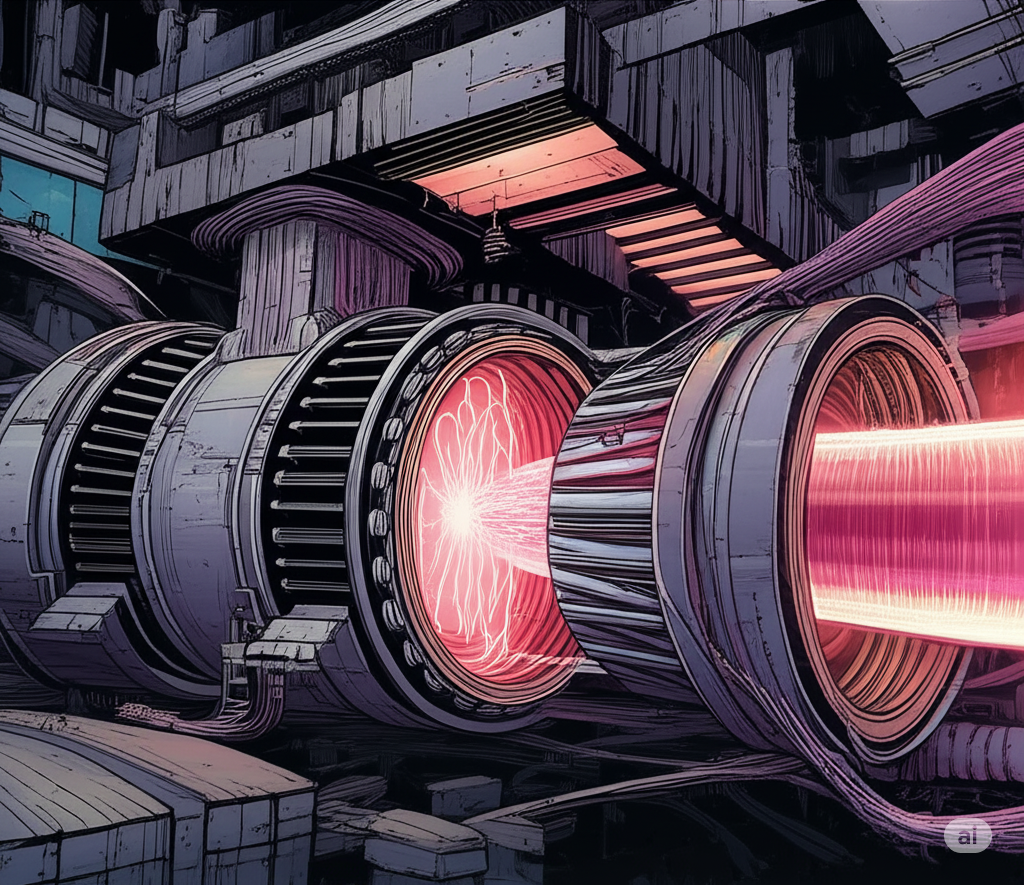
A third challenge is heating the plasma to fusion temperatures. Several methods are used to heat the plasma to the required 100 million degrees. These include ohmic heating (passing a powerful electrical current through the plasma), injecting beams of high-energy neutral particles that transfer their energy to the plasma, and using radio-frequency waves to resonate with and heat the plasma ions. Combining and optimizing these heating systems to efficiently bring the plasma to the target temperature and sustain it is a complex engineering task. The ultimate goal is to reach a state known as "ignition," where the energy released from the fusion reactions themselves (primarily from the helium alpha particles, which remain trapped by the magnetic field) is sufficient to keep the plasma hot without external heating. This is often referred to as a "burning plasma."
Finally, the challenge of tritium breeding is unique to the D-T fuel cycle. Tritium is a radioactive isotope with a half-life of only 12.3 years and is not found in nature in significant quantities. To create a self-sufficient fuel cycle, a fusion power plant must produce its own tritium. The proposed solution is to surround the plasma vessel with a "breeding blanket" containing lithium. The high-energy neutrons produced by the fusion reactions escape the magnetic confinement and strike the lithium nuclei in the blanket, triggering a reaction that produces tritium. This newly bred tritium must then be efficiently extracted and cycled back into the plasma as fuel. Designing a breeding blanket that can produce tritium at a rate equal to or greater than its consumption rate, all while withstanding the harsh reactor environment, is a major engineering hurdle that is yet to be demonstrated at scale.
3. Recent Breakthroughs and Experimental Successes
Despite the monumental challenges, the last decade has been a period of historic progress in fusion research, marked by several key breakthroughs that have reinvigorated the field and bolstered confidence in its ultimate success. These achievements have come from both major government-funded international collaborations and increasingly agile private companies, spanning both magnetic and inertial confinement approaches.
Perhaps the most significant milestone in recent history came in December 2022 from the National Ignition Facility (NIF) at Lawrence Livermore National Laboratory in the United States. NIF pursues a different approach to fusion called inertial confinement fusion (ICF). Instead of using magnetic fields, ICF uses incredibly powerful lasers to rapidly compress and heat a tiny pellet of deuterium and tritium fuel. On December 5, 2022, NIF made history by achieving "scientific breakeven" for the first time. In this experiment, 192 high-powered lasers delivered 2.05 megajoules (MJ) of energy to the fuel target, which then produced 3.15 MJ of fusion energy output. This represented a net energy gain, or a Q value, of approximately 1.5. This was the first time any fusion experiment in a controlled laboratory setting had produced more energy than was directly delivered to the fuel. The achievement was hailed as a monumental proof-of-principle, demonstrating that ignition is possible. The experiment was successfully replicated in August 2023, confirming the result and signaling a new era for ICF research.
In the realm of magnetic confinement, the Joint European Torus (JET) in the United Kingdom has consistently pushed the boundaries of what is possible in a tokamak. In a landmark experiment in late 2021 and early 2022, JET produced 59 MJ of sustained fusion energy over a five-second pulse. While this did not represent a net energy gain (the input energy was still higher than the output), it set a new world record for the total amount of fusion energy produced in a single experimental run. This was a critical demonstration of sustaining a stable, high-performance plasma over a timescale relevant to future power plants and provided invaluable data for the design and operation of its much larger successor, ITER (International Thermonuclear Experimental Reactor).
Innovations in magnet technology are also dramatically changing the landscape. Traditional fusion experiments rely on low-temperature superconducting magnets, which are bulky and complex. However, recent advances in high-temperature superconducting (HTS) materials have opened the door for a new class of smaller, more powerful magnets. In 2021, Commonwealth Fusion Systems (CFS), a spin-off from MIT, successfully tested a large-scale HTS magnet that achieved a field strength of 20 tesla, making it the most powerful fusion magnet of its kind ever created. This breakthrough is significant because the performance of a tokamak scales with the strength of the magnetic field to the fourth power. A stronger magnet allows for a much smaller and potentially cheaper reactor that can achieve the same level of performance as a larger device. CFS is now using this technology to build a compact net-energy demonstration device called SPARC, with the goal of achieving net energy gain by the mid-2020s. In a similar vein, in June 2024, the Chinese company Energy Singularity achieved the first plasma in its HH70 tokamak, the world's first to be built exclusively using HTS magnets.
Other notable successes include advancements in stellarators, an alternative magnetic confinement design to the tokamak that is inherently more stable but geometrically more complex. The Wendelstein 7-X stellarator in Germany achieved a major milestone in 2023 by sustaining a high-performance plasma with a gigajoule of energy turnover for a duration of eight minutes, demonstrating the potential for steady-state operation, a key advantage of the stellarator design. These collective breakthroughs, from achieving net energy gain to developing game-changing magnet technology and demonstrating long-pulse operation, have fundamentally altered the trajectory of fusion energy, making the prospect of a commercial reactor seem closer than ever before.
4. Economic Viability and Commercialization Pathways
As scientific breakthroughs bring fusion closer to technical reality, the focus is increasingly shifting towards the immense challenge of economic viability and the strategic pathways to commercialization. Proving that fusion can produce more energy than it consumes is a scientific milestone; proving it can do so affordably, reliably, and at a scale that can compete in the global energy market is an entirely different and equally complex problem. The journey from a successful experiment to a grid-connected power plant involves navigating a landscape of high capital costs, long development timelines, and evolving regulatory frameworks.
The most significant economic hurdle for fusion energy is the enormous upfront capital cost of constructing a power plant. The ITER project in France, a global scientific collaboration designed to demonstrate a burning plasma but not to generate electricity, has an estimated cost that has ballooned to over $25 billion, with a timeline that has been extended multiple times. While ITER is a first-of-its-kind research device, its cost highlights the financial challenge. The key to commercial viability will be to drastically reduce the cost of subsequent reactors. Proponents argue that this is achievable through technological learning, economies of scale, and innovations like the high-temperature superconducting (HTS) magnets being developed by private companies like Commonwealth Fusion Systems. These HTS magnets could enable smaller, more compact tokamaks that are cheaper and faster to build than a massive, ITER-scale device.
The timeline for commercialization is a subject of intense debate and speculation. For decades, fusion was jokingly said to be "always 30 years away." However, the recent surge in breakthroughs has led to more aggressive timelines. A growing number of private fusion companies are now targeting the early-to-mid 2030s for their first commercial pilot plants. A 2025 market report projected that the fusion energy sector could reach between $40 billion and $80 billion by 2035 and potentially exceed $350 billion by 2050, assuming key technological milestones are met. These timelines are ambitious and depend heavily on continued success in demonstration projects and the ability to attract sustained investment.
This leads to the second critical factor: investment. Historically, fusion research was almost exclusively funded by governments due to its long-term nature and high scientific risk. While government funding for projects like ITER remains crucial, the last decade has seen an explosion of private investment in fusion. By early 2025, private investment in the fusion industry had exceeded $7 billion. This influx of capital from venture funds, major energy corporations like Chevron and Shell, and tech billionaires has fueled a vibrant ecosystem of over 25 private fusion companies in the U.S. alone. These companies are exploring a diverse range of innovative approaches beyond the conventional tokamak, creating a competitive and dynamic environment that accelerates progress. Public-private partnerships are also emerging as a vital model, where government funding helps de-risk the early stages of research and development, enabling private companies to focus on the engineering and commercialization challenges.
Finally, the levelized cost of energy (LCOE) will be the ultimate determinant of fusion's success. The LCOE represents the average revenue per unit of electricity generated that would be required to recover the costs of building and operating a power plant over its lifetime. For fusion to be competitive, its LCOE must eventually be comparable to or lower than other clean energy sources like advanced fission, renewables paired with storage, and fossil fuels with carbon capture. Achieving a competitive LCOE will depend on factors such as the capital cost of the reactor, its operational efficiency (capacity factor), fuel costs (which are expected to be very low), and maintenance and decommissioning costs. The first fusion power plants are expected to be expensive, but proponents believe that, like solar and wind power, costs will decline significantly with technological maturity and scaled-up manufacturing.
5. Fusion’s Role in Global Energy Futures
As the world confronts the existential threat of climate change and the escalating demand for energy, the potential role of nuclear fusion in future sustainable energy systems is a topic of both immense hope and pragmatic debate. If successfully commercialized, fusion energy could become a cornerstone of the global energy transition, offering a unique combination of attributes that few other sources can match. Its primary contribution would be as a source of clean, safe, and reliable baseload power.
Unlike intermittent renewables such as solar and wind, which depend on weather conditions, a fusion power plant would be capable of operating continuously, 24/7. This makes it an ideal candidate to replace the baseload power currently provided by coal, natural gas, and conventional nuclear fission plants. In a future energy grid dominated by renewables, fusion could provide the firm, dispatchable power needed to ensure grid stability and reliability, especially during periods of low wind or sunshine. It would complement renewables, providing the constant power foundation upon which a variable energy system can be built.
The environmental advantages of fusion are profound. The process itself produces no carbon dioxide or other greenhouse gases, making it a powerful tool in the fight against climate change. Its fuel source, derived from water and lithium, is globally abundant and would eliminate the geopolitical tensions and supply chain vulnerabilities associated with fossil fuels. A key advantage over nuclear fission is the nature of its radioactive waste. Fusion reactors produce no high-level, long-lived nuclear waste. The activation of the reactor's structural materials results in waste that would need to be securely stored for approximately 100 years, a far more manageable timescale than the tens of thousands of years required for fission waste. Furthermore, the inherent safety of fusion reactors - with no risk of meltdown or runaway chain reactions - could help overcome public resistance to nuclear technologies.
However, it is critical to maintain a realistic perspective on the timeline. Most energy analysts and even many fusion proponents agree that fusion is unlikely to contribute significantly to achieving global climate goals by mid-century. The first commercial plants are not expected to come online until the 2030s at the earliest, and it will take several more decades to build out a fleet of fusion reactors large enough to make a substantial impact on the global energy mix. Therefore, fusion is not a silver bullet that absolves us of the need to aggressively deploy existing clean energy technologies like solar, wind, geothermal, and advanced energy storage today. The consensus is that fusion must not be used as an excuse to delay the urgent rollout of renewables.
Looking further into the future, beyond grid-scale electricity, fusion could unlock other energy-intensive applications. The high-temperature heat produced by fusion reactors could be used for industrial processes, such as producing green hydrogen through electrolysis, desalinating seawater, or synthesizing carbon-neutral fuels. This could help decarbonize hard-to-abate sectors of the economy where electrification is difficult. Projections from organizations like the International Energy Agency are beginning to incorporate fusion into long-term energy scenarios, recognizing its potential to be a game-changing technology in the latter half of the 21st century. The ultimate role of fusion will depend on its final cost-competitiveness, but its potential to provide a truly sustainable, secure, and powerful energy source for future generations makes its continued pursuit an indispensable part of planning for a clean energy future.
Conclusion
The pursuit of nuclear fusion energy remains one of the most audacious and inspiring scientific endeavors of our time. It is a journey from understanding the cosmic fire of the stars to the monumental challenge of containing that fire within a terrestrial machine. For decades, this journey has been defined by immense scientific and engineering hurdles - from confining a 100-million-degree plasma to developing materials that can withstand an environment of unprecedented hostility. These challenges are not yet fully overcome, but the ground has fundamentally shifted. The recent wave of breakthroughs, including the historic achievement of net energy gain at the National Ignition Facility and the rapid advancement of high-temperature superconducting magnets, has transformed the field. Fusion is no longer a distant dream perpetually "30 years away"; it is a tangible technology on a credible, albeit still challenging, path to commercialization.
Our exploration has traversed the foundational principles that distinguish fusion's clean and safe profile from fission, delved into the deep technical chasms of plasma physics and materials science that researchers are steadily crossing, and celebrated the landmark successes that now illuminate the path forward. We have also examined the pragmatic realities of economic viability, where a surge in private investment is now driving innovation at an unprecedented pace, with the goal of making fusion power not just possible, but affordable. The first commercial fusion plants, targeted for the 2030s, will be the ultimate test of these efforts.
In the grand scheme of the global energy transition, fusion is not a short-term solution but a long-term aspiration with transformative potential. It will not replace the urgent need to deploy renewables and other clean technologies today. Instead, it offers the promise of a powerful new tool for the latter half of this century - a source of clean, abundant, and reliable baseload power that can anchor a sustainable energy system for millennia. The quest to forge a star on Earth continues, no longer a matter of 'if,' but of 'when,' driven by the conviction that mastering this process will secure a cleaner, safer, and more prosperous energy future for all of humanity.
What's Your Reaction?