Exploring a World Without Rulers: Understanding Anarchism
Imagine a world without governments, without police, without presidents or prime ministers. A world where society organizes itself, not through top-down authority, but through voluntary cooperation and mutual respect. Sounds utopian? Or terrifying? This is the world envisioned by anarchism, a political philosophy that challenges the very necessity of government and hierarchy. But what exactly is anarchism? Is it just chaos and disorder? Or is there a coherent vision for a different kind of society? Let's dive into the core ideas of anarchism, explore its different forms, and consider the arguments for and against a world without rulers.
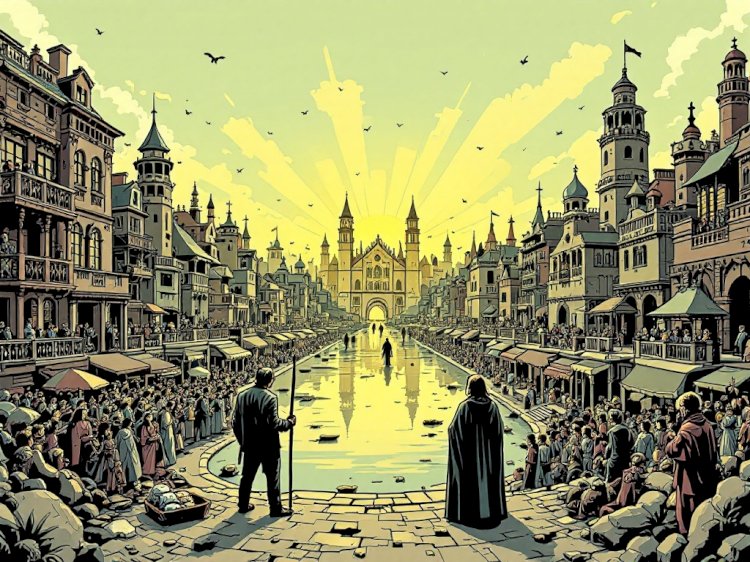
What is Anarchism? Beyond the Stereotypes
The word "anarchy" often conjures images of mayhem and lawlessness. However, at its heart, anarchism is not about chaos, but about order without rulers. The term itself comes from the Greek "anarkhia," meaning "without ruler." As a political philosophy, anarchism fundamentally questions the legitimacy and necessity of hierarchical power structures, especially the state.
Anarchists believe that government, in all its forms, is inherently oppressive and harmful. They argue that states rely on coercion and violence to maintain control, limiting individual freedom and hindering genuine social progress. Instead of centralized authority, anarchism proposes alternative forms of social organization based on voluntary association, mutual aid, and direct democracy.
Key tenets of anarchism include:
- Rejection of Hierarchy: Anarchism opposes all forms of unjust hierarchy, whether political, economic, or social. This includes not just the state, but also capitalism, patriarchy, racism, and other systems of domination.
- Individual Liberty and Autonomy: A core value is the freedom of the individual to make choices about their own life. Anarchists believe in maximizing individual autonomy and self-determination.
- Voluntary Association: Anarchist society is envisioned as being built upon voluntary associations and cooperation, rather than compulsory laws and state control. People would freely associate to meet their needs and achieve common goals.
- Mutual Aid: Anarchists emphasize mutual aid – voluntary reciprocal exchange of resources and services – as a fundamental principle of social organization. This cooperation, they argue, is a natural human tendency and a more effective basis for society than competition and state control.
- Direct Democracy and Decentralization: Decision-making in an anarchist society would be decentralized and participatory, often through direct democracy or consensus-based processes at the local level.
A Spectrum of Anarchist Thought: Exploring Different Types
Anarchism is not a monolithic ideology. Within anarchism, there is a diverse range of schools of thought, each with its own nuances and priorities. Some of the main types include:
- Anarcho-Communism: This influential branch advocates for the abolition of both the state and capitalism, envisioning a stateless, classless society based on communal ownership of the means of production and distribution based on need. Key thinkers include Peter Kropotkin and Emma Goldman. Anarcho-communists believe in "from each according to his ability, to each according to his needs."
- Anarcho-Syndicalism: Focusing on labor movements, anarcho-syndicalism emphasizes worker self-management and the abolition of the wage system. It proposes replacing capitalism and the state with decentralized federations of worker-controlled syndicates or unions. These syndicates would manage production and distribution democratically.
- Anarcho-Collectivism: A close relative to anarcho-communism, collectivist anarchism emphasizes collective ownership, but with distribution based on labor contribution ("to each according to his deeds"). It is associated with Mikhail Bakunin and emphasizes revolutionary means to achieve anarchism.
- Individualist Anarchism: This tradition prioritizes individual liberty and autonomy above all else. Individualist anarchists often advocate for free markets and private property, but reject state intervention and coercion. Thinkers like Josiah Warren and Benjamin Tucker are key figures.
- Mutualism: Developed by Pierre-Joseph Proudhon, mutualism proposes a society based on reciprocity, free association, voluntary contract, federation, and credit and currency reform. It sits between individualist and collectivist anarchism, advocating for a market economy without profit, usury, or exploitation.
- Anarcho-Primitivism: A more radical and controversial form, anarcho-primitivism critiques industrial civilization and technology, advocating for a return to a pre-industrial, often hunter-gatherer, way of life. They see civilization and technology as inherently linked to hierarchy and environmental destruction.
- Green Anarchism/Eco-Anarchism: This branch combines anarchist principles with environmental concerns. It critiques human domination of nature and advocates for ecological sustainability and decentralized, eco-friendly living.
This spectrum highlights that anarchism is not a rigid dogma, but a dynamic and evolving set of ideas. Different anarchists prioritize different values and propose different strategies for achieving a stateless society.
Historical Examples and Modern Relevance
While a fully realized anarchist society has never existed on a large scale, anarchist ideas have inspired numerous social movements and historical moments.
- The Spanish Revolution (1936-1939): During the Spanish Civil War, anarchist and anarcho-syndicalist organizations played a significant role, particularly in Catalonia and Aragon. They collectivized land and factories, establishing worker-managed collectives and experimenting with anarchist forms of social organization. This period, though ultimately crushed by Franco's forces, remains a powerful example of anarchist principles in practice.
- The Paris Commune (1871): This brief but impactful revolutionary government in Paris was influenced by anarchist and socialist ideas. It implemented radical democratic reforms and worker-friendly policies before being brutally suppressed.
- Zapatista Communities in Chiapas, Mexico: Since the 1990s, the Zapatista Army of National Liberation (EZLN) in Chiapas, Mexico, has created autonomous, self-governing communities based on anarchist principles of direct democracy, autonomy, and mutual aid. They offer a contemporary example of anarchist practice in action.
- Mutual Aid Networks: Throughout history and in contemporary society, mutual aid networks exemplify anarchist principles in action. From community gardens and food banks to disaster relief efforts and online support groups, these initiatives demonstrate the power of voluntary cooperation to meet needs outside of state or capitalist structures. The COVID-19 pandemic saw a surge in mutual aid groups globally, highlighting the continued relevance of these ideas.
Anarchist ideas continue to resonate in contemporary social movements, including anti-globalization, environmental justice, and Occupy movements. They offer a critical lens for analyzing power structures and inspire ongoing experiments in decentralized, participatory forms of organization.
Criticisms and Challenges of Anarchism
Despite its inspiring vision, anarchism faces significant criticisms and challenges:
- Impracticality and Utopianism: Critics argue that anarchism is unrealistic and utopian. They question whether a complex modern society can function without a state to enforce laws, provide essential services, and maintain order. The challenge of coordinating large-scale projects and addressing collective problems in a stateless society is often raised.
- Human Nature and Social Order: Skeptics question the anarchist assumption that humans are inherently cooperative and capable of self-governance without coercion. They argue that without a state, society would descend into chaos, violence, and conflict, as individuals and groups pursue their own self-interests.
- Defense and Security: How would an anarchist society defend itself against external threats or internal violence without a centralized military or police force? This is a major challenge for anarchist theory, with various proposed solutions ranging from decentralized militias to non-violent resistance.
- Economic Viability: The economic models proposed by different anarchist schools, particularly anarcho-communism, are often criticized as inefficient or unsustainable. Questions are raised about incentives for production, resource allocation, and technological innovation in a stateless, classless economy.
- Historical Challenges: The historical examples of anarchist practice, while inspiring, have often been short-lived or limited in scale. Critics point to the suppression of the Spanish Revolution and the Paris Commune as evidence of the difficulties in sustaining anarchist societies in the face of state power.
Is a World Without Rulers Possible?
Anarchism raises profound questions about power, authority, and the nature of society. While the practical challenges of implementing full-scale anarchism are undeniable, the philosophy offers valuable insights and critiques of existing power structures.
Even if a complete anarchist utopia remains elusive, anarchist principles can inform and inspire efforts to create more just, equitable, and participatory societies within and beyond the existing state system. Focusing on decentralization, mutual aid, direct democracy, and challenging unjust hierarchies can contribute to building more free and cooperative communities, regardless of whether the state is ultimately abolished.
The debate about anarchism continues, and its enduring appeal lies in its radical vision of a world where people govern themselves, free from domination and coercion. Whether this vision is achievable or not, exploring anarchist ideas pushes us to critically examine the nature of power and imagine alternative possibilities for social organization.
What's Your Reaction?